Photo Cred: (1) | Updated: 11-18-2020
About a year ago when I worked at Staples, I had a conversation on faith that was fantastic with one of the coworkers on my sales team. It was one of those moments you pray for and ask God for the awareness to know when one of those moments is happening. As Christians, we call this discernment. The ability to be sensitive to the Holy Spirit and what he is doing in the present.
Oddly enough, this conversation was initiated by her when she rolled by my desk and asked a few questions about my faith. This was pretty common because she did this with everyone as an extrovert and loved chatting with everybody on the team, but the subject of our conversation was brand new. It was something we never talked about before and I was very excited to have this conversation because I’m always waiting for these moments to happen.
Unlike most people, I have a different motivation for why I go to work. It’s not for money or the type of work I’m doing necessarily, but rather comes down to a very simple question: what spiritually needs to be done here? That’s my motivation that guides everything I do at work and in life overall. Every day and every moment guided by that simple question. On this day during this moment, I knew what spiritually needed to be done. I needed to answer her question, but not the one she was asking.
When someone is searching their own soul, they tend to discover holes within their worldview. For my coworker, this hole within her worldview was related to her experience with Christianity as a person who grew up Catholic. Her being a Hispanic American that grew up within the family’s strong Catholic tradition lends credence to the idea that maybe her faith wasn’t genuine. Maybe this routine of rituals never actually meant a real relationship with God himself. Maybe the faith she thought she had with its rules and regulations never materialized in her adulthood into something real.
The Conversation
The conversation started with her asking, “You’re religious, right?” and I said yes. She then asked if I was Christian or Catholic. I said I was both, which compelled her to ask how I could be both. I replied that my theology is predominantly Catholic, but my convictions are predominantly Protestant. For instance, my theology is inspired by the Jesuit school of thought called Molinism, but I align a lot with the Anabaptist movement as well. I’m a clear mix of these two different sides of Christianity after studying both for myself.
This answer seemed to resolve her surface-level questions, but now it was my turn. I asked “You’re Catholic, right?” and she said yes. She explained that she grew up Catholic, but doesn’t practice the faith like her family does. I followed up with my next question, “Why not?” and that’s when the real questions came to the surface.
Here she shared how the showy stuff never clicked with her, but that she knows that there must be something like God because she has experienced him growing up. She heard that I was Christian and just wanted to know if what she experienced was real. This is a question we should all ask ourselves. Is what I’m experiencing God or is this something else?
The Scale of Faith
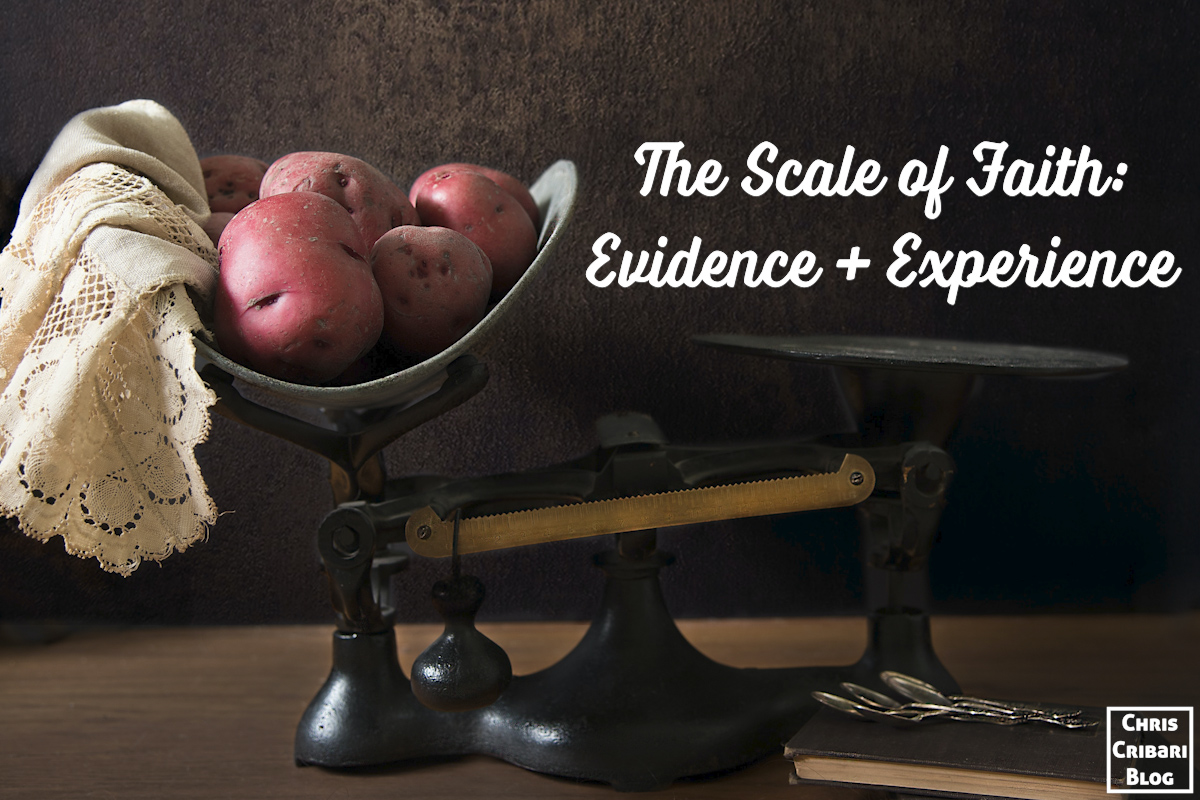
I don’t remember everything that I shared with her, but I do remember the crux of my point. Essentially, faith in God is a scale that’s balancing between evidence and experience. In general, the Christian life is a strange combination of undeniable evidences and unexplainable experiences.
Like my former coworker, we too experience things that we cannot explain and yet know intuitively that this must be God. Likewise, we also observe and measure things in life that logically lead us to God. We all in one way or another experience God and have evidence that God exists in our reality. The key is finding the balance between these two components for a healthy Christian faith.
An Evident God
When we focus too much on evidence, we drown in the rabbithole of not knowing enough. Put simply, you will never know enough about God or be able to define him anymore than he has defined himself for us. As King Solomon put it, “there is nothing new under the sun (2).” There is no secret knowledge that remains undiscovered about God that we can find.
He has intentionally given us all we need to know about him and yet leaves it hidden for us to discover for ourselves. Many avenues in fact from history to mathematics or philosophy and science, but none of them leads to the full knowledge of God. If we knew everything there is to know about God, then he wouldn’t be God. Like any person you come across in life, you will never know everything about them and the same can be said of God.
Then again, faith requires evidence. It’s demanded by our minds trying to make sense of the unknown in the best way that we can, so this doesn’t mean we throw out logic and reason. Instead, this just means we search until we find the edge of knowing God and admire the mystery that stands before us. When we know God and are known by him, then we will know who we are and what we were made to do.
The God Experience
With experience, we find ourselves in the murky waters of the abstract and what has been felt in the fleeting memories of our unique moments with God. It’s not meant to be explained because these moments are to be lived in and felt with all our being. It’s the knowledge of being there that counts and not the incalculable details of the moment.
Why do some dream of Jesus and immediately become Christian, despite every reason to remain a part of their current faith? We don’t know and that’s because it’s not our experience to explain. It’s not our story to tell, but their honor to tell it as a critical piece to the unfinished puzzle that is their life in Christ. These experiences with God are once-in-a-lifetime and at the same respect unforgettable.
Conclusion
Her experience could very well have been God. She didn’t need to doubt it per se because only she would know if it was genuinely a God moment. With discernment, I believe what she shared was a God moment and affirmed it as such to her by the end of our talk.
What I left her with was a challenge: “You seem to know what it’s like to experience God, but is God evident in your life? Before you write off God or your faith from your childhood, look at it again and see if there’s anything to your faith. Could this really be true? You experienced it, so now it’s time to find out if there’s evidence.” Our boss walked by and that’s when we got back to work, but I still hope to this day that she takes the time to reevaluate her faith.
Was the experience truly God or something she made up? Could God be evident in her life? If Jesus is a real person, then is what he said true? Those are questions that only she can answer for herself.
I can’t change minds, but I can compliment critical thinking with the best case for the Christian faith. That case starts when we examine the scale of faith to see if evidence and experience meet at the cross of Christ. With that, Godspeed and Jesus bless.
Footnotes
- Free stock photos · Pexels
- Ecclesiastes 1:9 (NASB)


 chris cribari blog