Legalism: Movies + Music

Photo Cred: (1) | Updated: 5/21/2019

Although there are many global issues I could write about that are very prevalent in the world today, today I would like to talk about an issue that may seem minor, but can result in cataclysmic effects in Christianity. The issue I want to talk about is legalism. Since legalism is too large of a topic on its own, I am going to narrow down my discussion to two things: movies and music.

This post was inspired by a couple things and experiences from the past. Namely an open letter written by John Givez to Christian Hip Hop that was posted by Rapzilla (2) and a conversation I had with my good friend Jeremiah. In John Givez’ open letter to CHH, he touches on the stigma that is attached to him because everyone considers him to be so edgy that he has lost his spiritual edge, so to speak. That the way he operates and lives his life is not like the typical white, suburban, Evangelical-Christian. You know, that typical generalization and stereotype of every Christian in America. Take me for instance: the guy that looks like the 99 cent version of Leonardo Dicaprio, but who also always looks like he either just got back from the gym or is about to go to one.

Yet as Christians, we project these misconceptions of what a Christian should look, talk, and act like. These legalistic type and their keyboard warriors decided to call out John Givez for the way he lives his life and the way he goes about impacting the culture. So John Givez wrote a response letter to answer his skeptics. Then after reading the letter, I talked to my friend Jeremiah about legalism which led to a discussion on movies and music.

We talked about how we feel convicted by certain things that the other is not convicted to such an extreme degree. For instance, my friend is not comfortable watching an R-rated movie usually, but I on the other hand don’t mind depending on why it is rated R. Then when it comes to music we are again at opposite ends of the spectrum, but the positions are reversed. I cannot listen to music with foul language, but my friend is a lot more open to it then I am which is fine. I mean, I have no place to call out my friend for listening to music with foul language, if I watch movies with foul language. Right?

Now I am a film fanatic and I actually went to film school, so I am biased towards watching films over listening to music. I grew up watching war movies with my Dad and brothers late at night all throughout my childhood. War movies like Saving Private Ryan, Braveheart, We Were Soldiers, Gladiator, and so on that were very R-ratedWhen it comes to music on the other hand, I am a lot more cautious and skeptical to what I listen too.

In fact, I could count how many secular artists that I listen too off the top of my head on a regular basis. So now I ask myself, “Why is it that I am so restrictive towards music when it comes to whether or not it is Christian creators, but when it comes to my movie collection it is exclusively secular?” Why is that? Why do hold to this double-standard like a lot of other Christians?

I know for me personally that I honestly hate nearly every movie made by Christians because they are usually garbage, with the one exception being The Case For Christ movie which was actually pretty good. That may play a part in why I have more secular movies in my possession than secular music because there is a smaller supply of quality, Christian-oriented films that are also good. When comparing how many Christians are in the movie industry versus the music industry, it is pretty evident where the quality is best. In general, Christians in the movie industry are a joke compared to the Grammy-winning Christians in the movie industry.

Going back to legalism, when does someone go too far in what content they consume like movies or music? When is it okay for a fellow believer to correct another believer in love on what they are participating in? The best answer I can come to is that someone who has gone too far in whatever they are doing, is someone who is a) not glorifying God and b) is not reflecting Christ. If you can listen to secular music or watch secular movies, and not be hindered spiritually then go for it. If not, then you might want to reconsider what you are interested in as far as movies and music go.

For me, I have set up certain boundaries to ensure that I do not stumble into sin by going too far when it comes to these two mediums of art. This includes reading reviews from Common Sense Media (3), which is a website that tells you the content of most media and to what degree of content. For instance, Mission Impossible: Ghost Protocol has a 4 out of 5 stars for violence on Common Sense Media‘s review of the film, which means there is a lot of violence throughout the movie.

It could also be how you started your relationship with Jesus and became a Christian that influences what your specific borders for certain non-essential beliefs are going to be in your life. For example, I have these old family friends whose sons had such violent tendencies that just watching violent films would influence them to act extremely violently towards each other. So for that family, violent movies were not allowed because it tempted the two brothers into sinning towards each other.

Paul the Apostle wrote about legalism in two different places: Colossians 2:16-23 and Romans chapter 14. In the end, I could continue to discuss and try providing answers, but really I cannot truly say why I have certain standards for these two different mediums of entertainment. I will need to investigate and understand what pulls me away from God and draw borders accordingly on my own. One way you could go about finding safe boundaries for yourself is by studying these two passages in the Bible and understanding what hinders you or what doesn’t hinder you as a Christian. Like always, I hope this helps you if this is something that you struggle with in your life. With that, Godspeed and Jesus bless!

Footnotes

  1. https://rapzilla.com/2015-08-john-givez-pens-open-letter-to-christian-hip-hop/
  2. http://www.rapzilla.com/rz/news/38-backstage/11361-john-givez-pens-open-letter-to-christian-hip-hop
  3. https://www.commonsensemedia.org/
  4. Disclaimer

Why I Am Not A Calvinist

Photo Cred: (1) | Updated: 5/21/2019

 In the first installment of my “Why I Am” series, I will be giving three brief reasons as to why I do not adhere to the Judeo-Christian school of thought known as Calvinism. As I have studied and read about Calvinism, there have been many sources I have used to write this blog-post. Some of these sources were Norman Geisler’s sermon called “Why I Am Not a 5 Point Calvinist” (2), George L. Bryson’s book on Calvinism (3), and Tim Stratton’s 4-part series “The Petals Drop” on his website (4). There were other resources, but these were the main three that inspired me to write this blog-post.

So what is Calvinism exactly? Calvinism is a type of Christian doctrine created in the 16th Century by the French Theologian John Calvin to answer how God’s Sovereignty and Humanity’s Free Will coexist together. There are five main parts to Calvinism. According to gotquestions.org (5), Calvinism can be summarized by the acronym TULIP and is defined as the following:

  1. Total Depravity: “Every aspect of humanity is tainted by sin; therefore, human beings are unable to come to God on their own accord.”
  2. Unconditional Election: “God elects individuals to salvation based entirely on His will, not on anything inherently worthy in the individual.”
  3. Limited Atonement: “Jesus only died for the elect.”
  4. Irresistible Grace: “When God calls a person to salvation, that person will inevitably come to salvation.”
  5. Perseverance of the Saints: “A person who is elected by God will persevere in faith and will not permanently deny Christ or turn away from Him.”

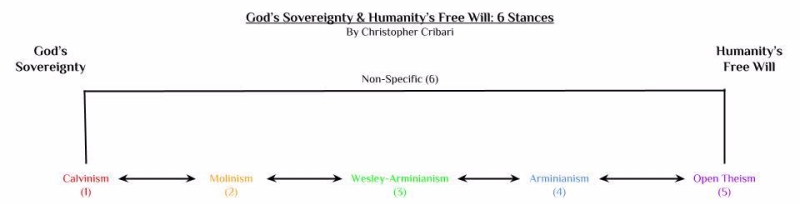
In other words, a Calvinist is a Christian that sees everything with an over-emphasis on God’s Sovereignty, which entails either a deterministic or compatibilistic philosopical view of the world. Here is a quick illustration that I made to put into perspective where Calvinism stands in the grand spectrum of the issue of God’s Sovereignty vs. Humanity’s Free Will within Christianity:

God's Sovereignty & Humanity's Free Will- 6 Stances

One last thing is that when I refer to a Calvinist or Calvinism, I am referring to a 5-Point Calvinist. Not those that claim to be any combination that is short of a 5-Point Calvinist like a 4-Point Calvinist or a 2-Point Calvinist. But the whole point of the 5 points of Calvinism is that they are supposed to work together like the pillars to a building. By removing one point you fracture the legitimacy of the other four points and the foundation of Calvinism in general because they were designed by John Calvin to work together, not to work independently of each other. With that said, let’s look at my objections and see why I am not a Calvinist.

1) Calvinism is Great Exegesis Without Hermeneutics

In general, with the Calvinistic perspective on Scripture, there are massive misinterpretations of certain passages within the Bible. Most notably, Scriptures such as Romans chapters 9-11, John chapter 6, Ephesians 1:1-4, and the list goes on. In contrast, there are Scriptures like 1 John 2:2, Romans 1:16-17, or 1 Timothy 2:3-6 that explicitly go against Calvinism. Put simply, context is key and exegesis without context is like a madman with a sword.

2) Calvinism Makes Sharing the Gospel Logically Incoherent

If you think about the Gospel from the Calvinist perspective, Jesus only came to save the elect, only the elect will go to Heaven, and only the elect will get saved. So then sharing the Gospel becomes useless and pointless because those who are predestined to go to Heaven will go to Heaven and those who are predestined to go to Hell will go to Hell, while at the same time you have no say in the matter.  As Bryson put it in his book, The Five Points of Calvinism, “You will be saved or damned for all eternity because you were saved or damned from all eternity.” (Bryson, 121). Although some of the most prominent preachers have been Calvinists like Charles Spurgeon, their actions are not logically consistent with determinism. It is the equivalent of preaching to tombstones because no matter what some people are just doomed to damnation because it somehow glorifies God.

3) Calvinism Makes God the Author of Evil

If God is completely sovereign, then from the Calvinistic perspective God is the author of evil because He brought it into existence. This goes against everything that characterizes God as worthy of worship and completely good. How can a perfect being bring about imperfection? Only through the Calvinistic perspective is this possible because God is the cause of everything that exists including evil, instead of Eve and Lucifer bringing sin into God’s creation by going against God in their own free will. Philosopher William Lane Craig on the subject of Calvinism once said “according to this view (causal determinism and compatibilism), the way in which God sovereignly controls everything that happens is by causing it to happen, and freedom is re-interpreted to be consistent with being causally determined by factors outside oneself (6).”

So since God is ultimately the first cause of everything, God is therefore the author of evil and good. Something that is completely contradictory to the Bible and Judeo-Christianity as a whole. There are even Calvinist’s that affirm that God is the author of evil. People like R.C. Sproul Jr. affirm this idea of God being the author of evil several times throughout his book (7) that deals with this issue.

Now these are just 3 of many objections I have to Calvinism and are just reasons as to why I do not affirm to be Calvinist. Other objections I have include sin being excusable or God lying to people in the Bible, but that would take awhile to explain every objection I have to Calvinism, so for the sake of time I only chose 3 objections. Hopefully, this helps you with understanding this issue and maybe one day you can decide where you stand on the issue of how God’s Sovereignty and Humanity’s Free Will interact together. My advice for those of you do not understand this issue quite yet is to just believe what the Bible affirms: 1) that God is Sovereign and 2) that humans have Free Will. This is the safest stance concerning this issue because it is strictly Biblical avoids the gridlock nature of philosophical schools of thought like Calvinism among others. With that, Godspeed and Jesus bless!

Footnotes

  1. https://restorethegospel.wordpress.com/2009/11/19/a-conversation-about-calvinism-and-arminianism/
  2. https://youtu.be/fPpkSiO1Ci
  3. The Five Points of Calvinism, George L. Bryson
  4. http://freethinkingministries.com/the-petals-drop-why-calvinism-is-impossible/
  5. https://www.gotquestions.org/Calvinism-vs-Arminianism.html
  6. http://www.reasonablefaith.org/molinism-vs-calvinism
  7. http://www.reclaimingthemind.org/blog/2008/09/taking-calvinism-too-far-rc-sproul-jr%E2%80%99s-evil-creating-deity/http://amzn.to/2xM4F1Q
  8. Disclaimer