Updated: 5/15/2026
Sermon Prep
In the news at the time, the government shutdown from October through half of November in 2025. This historical shutdown which ended four days before this message impacted 40 million people depending on SNAP benefits to survive the tough economy. In those 43 days, we heard stories locally and nationally of people just trying nearly any means necessary to get food on the table without that essential government aid. It was a scary time for a lot of people both directly and indirectly impacted by this shutdown and the loss of benefits.
This backdrop also influenced how I wrote this sermon. Now yes, it effected the other previous sermons too in retrospect but consciously I was thinking about those 40 million people in need when I wrote this message. To struggle for 43 days and figure out how to feed your family during that time must’ve been beyond stressful for so many Americans. It really bothered me and our church did end up helping because we too noticed that societal strain in our community. But even still, we could only help so many compared to the gap not being met. There was a lot of hurt and worry in the Fall of 2025.
So when it came to this message I unlike most messages leaned a little into the political to drive home the application. To drive home that we who have plenty and we are well must be there for those who have little and have been hurt. I always struggle with what to or not to include politically because it honestly infects every corner of life now which is frustrating. It’s the new American religion to worship a politician over the person of Jesus. It’s embarrassing and I think my thoughts on that bled here into this here text. On that note, here’s the YouTube recording and the sermon notes:
Sermon Notes
Opening Prayer
- Father God, lead us this morning as we search the scriptures. Thank you for your Son whose sacrifice is our salvation. Would you speak through me, in spite of me, and beyond me. Dwell with us, Holy Spirit, as you teach us today. In your name, amen.
Intro
- Story of trying to take control in buying a home, yet finding a townhouse in the end.
Main Point
- When we rush God’s plan and try to take control, someone always gets hurt.
- Every spiritual scar tells a story, but Jesus shares in our suffering.
Share in Our Sufferings | Genesis 16:1-14, 21:9-21 (NRSVue)
“[1] Now Sarai, Abram’s wife, bore him no children. She had an Egyptian slave whose name was Hagar, [2] and Sarai said to Abram, “You see that the Lord has prevented me from bearing children; go in to my slave; it may be that I shall obtain children by her.” And Abram listened to the voice of Sarai. [3] So, after Abram had lived ten years in the land of Canaan, Sarai, Abram’s wife, took Hagar the Egyptian, her slave, and gave her to her husband Abram as a wife. [4] He went in to Hagar, and she conceived, and when she saw that she had conceived, she looked with contempt on her mistress. [5] Then Sarai said to Abram, “May the wrong done to me be on you! I gave my slave to your embrace, and when she saw that she had conceived, she looked on me with contempt. May the Lord judge between you and me!” [6] But Abram said to Sarai, “Your slave is in your power; do to her as you please.” Then Sarai dealt harshly with her, and she ran away from her. [7] The angel of the Lord found her by a spring of water in the wilderness, the spring on the way to Shur. [8] And he said, “Hagar, slave of Sarai, where have you come from and where are you going?” She said, “I am running away from my mistress Sarai.” [9] The angel of the Lord said to her, “Return to your mistress, and submit to her.” [10] The angel of the Lord also said to her, “I will so greatly multiply your offspring that they cannot be counted for multitude.” [11] And the angel of the Lord said to her, “Now you have conceived and shall bear a son; you shall call him Ishmael, for the Lord has given heed to your affliction. [12] He shall be a wild ass of a man, with his hand against everyone, and everyone’s hand against him, and he shall live at odds with all his kin.” [13] So she named the Lord who spoke to her, “You are El-roi,” for she said, “Have I really seen God and remained alive after seeing him?” [14] Therefore the well was called Beer-lahai-roi; it lies between Kadesh and Bered.”
- Hagar was potentially taken as a slave by Sarai when they were in Egypt (i.e. Genesis 12).
- Sarai enacts a common ANE law where a slave bears children for the wife (Genesis 16:2).
- Abram listening to Sarai parallels Adam listening to Eve instead of God (Genesis 16:3).
- Ishmael means God hears; Muslims claim he is Muhammed’s ancestor (Genesis 16:11).
- El-roi means the God who sees me and is the first time God is named (Genesis 16:13).
“[9] But Sarah saw the son of Hagar the Egyptian, whom she had borne to Abraham, playing with her son Isaac. [10] So she said to Abraham, “Cast out this slave woman with her son, for the son of this slave woman shall not inherit along with my son Isaac.” [11] The matter was very distressing to Abraham on account of his son. [12] But God said to Abraham, “Do not be distressed because of the boy and because of your slave woman; whatever Sarah says to you, do as she tells you, for it is through Isaac that offspring shall be named for you. [13] As for the son of the slave woman, I will make a nation of him also, because he is your offspring.” [14] So Abraham rose early in the morning and took bread and a skin of water and gave it to Hagar, putting it on her shoulder, along with the child, and sent her away. And she departed and wandered about in the wilderness of Beer-sheba. [15] When the water in the skin was gone, she cast the child under one of the bushes. [16] Then she went and sat down opposite him a good way off, about the distance of a bowshot, for she said, “Do not let me look on the death of the child.” And as she sat opposite him, she lifted up her voice and wept. [17] And God heard the voice of the boy, and the angel of God called to Hagar from heaven and said to her, “What troubles you, Hagar? Do not be afraid, for God has heard the voice of the boy where he is. [18] Come, lift up the boy and hold him fast with your hand, for I will make a great nation of him.” [19] Then God opened her eyes, and she saw a well of water. She went and filled the skin with water and gave the boy a drink. [20] God was with the boy, and he grew up; he lived in the wilderness and became an expert with the bow. [21] He lived in the wilderness of Paran, and his mother got a wife for him from the land of Egypt.”
- Scholarship and Tradition agree that the “the angel of the Lord” in Genesis 16 is a Christophany, while “the angel of God” in Genesis 21 is just a messenger for God.
- Hagar receives a similar promise to Abraham in that God will provide and make a nation.
Why It Matters
- Abram and Sarai disobeyed, took control, and exploited Hagar creating generational sin.
- Church hurt causes deep wounds that are real, but God is here for the hurting.
Power Text
“[21] “You shall not wrong or oppress a resident alien, for you were aliens in the land of Egypt. [22] You shall not abuse any widow or orphan. [23] If you do abuse them, when they cry out to me, I will surely heed their cry; [24] my wrath will burn, and I will kill you with the sword” – Exodus 22:21-24b (NRSVue)
- Under the Law, God commands Israel to defend the alien, powerless, and vulnerable.
“[32] All the nations will be gathered before him, and he will separate people one from another as a shepherd separates the sheep from the goats, [33] and he will put the sheep at his right hand and the goats at the left… [40] And the king will answer [the right ones], ‘Truly I tell you, just as you did it to one of the least of these brothers and sisters of mine, you did it to me.’” – Matthew 25:32-33, 40 (NRSVue)
- The final judgement is tied to good works towards the alien, powerless, and vulnerable.
- Jesus not only has empathy for the hurting, but shares in their sufferings too.
- He suffered physically on the cross, had sexual shame when the Romans publicly stripped him naked, and spiritual alienation from the Father.
- Jesus not only has empathy for the hurting, but shares in their sufferings too.
Outro
“[16] We know love by this, that he laid down his life for us—and we ought to lay down our lives for the brothers and sisters. [17] How does God’s love abide in anyone who has the world’s goods and sees a brother or sister in need and yet refuses help? [18] Little children, let us love not in word or speech but in deed and truth.” – 1 John 3:16-18 (NRSVue)
- Under God’s grace, right belief naturally compels us to right behavior as his Church.
- If you carry church hurt, bring that to God who hears, loves, and sees you.
- If you’ve wounded others, repent and help those you hurt to heal.
- If you carry church hurt, bring that to God who hears, loves, and sees you.
Final Thoughts
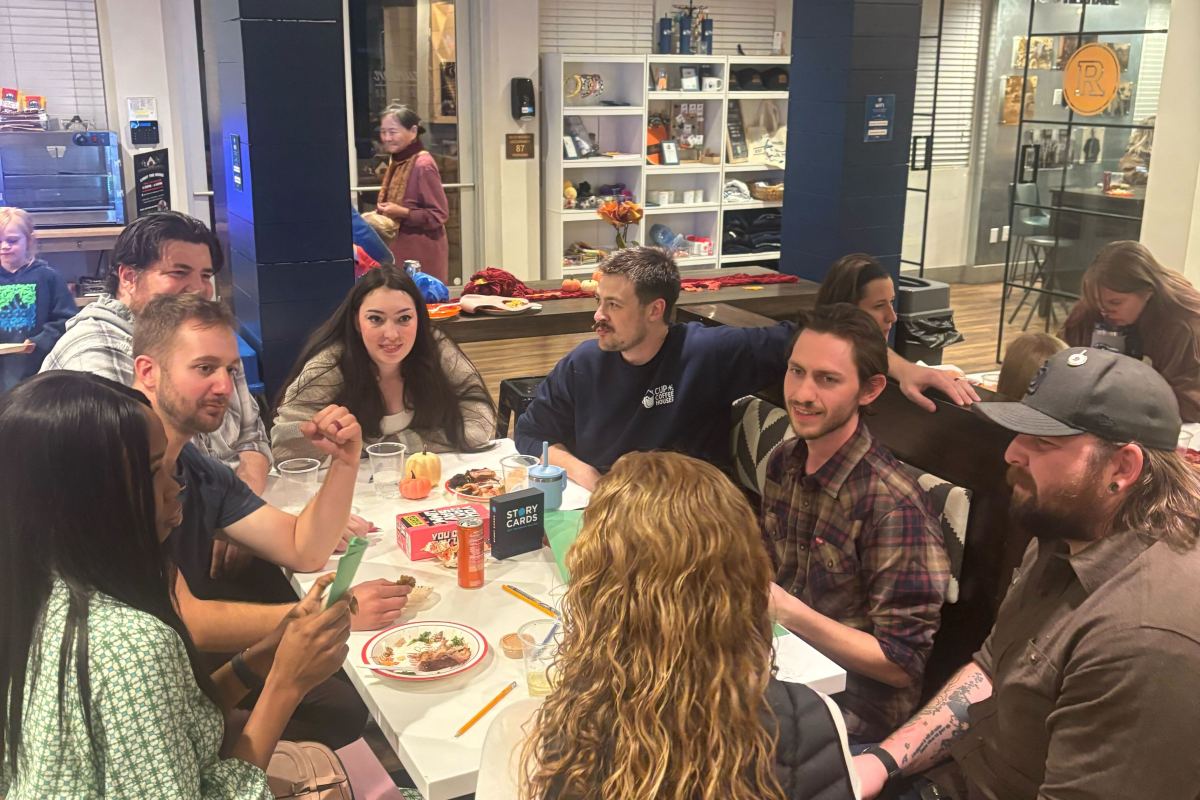
The picture for this blogpost ironically comes from our annul Friendsgiving we do as a church. As you can see by the time Thanksgiving week rolled around, our community was better than ever. There was laughter and joy again, which is always the best company to have around.
People were hesitant to talk during small groups after the message. I think the subject matter of church hurt, the current political climate, and just talking about suffering in general makes everyone uncomfortable. As we were packing up, I overhead one of our teachers question the sexual shame bit, which to be fair is a minority view.
There has been more recent scholarship from the likes of Brent Kinman, Jerome Neyrey, Marika Rose and Katie Edwards, along with others as well. At this time I had incorporated this concept into my own book and relied on work from David Tombs exclusively. I’m a bit on the fence with this specific concept, but I included it simply to challenge our congregation. If you only hear things you agree with, then are you really growing in Christ? Growth is uncomfortable and so too is learning when presented with new ideas.
As for the sermon, I thought I did well with the material overall. I was especially proud of how I included so many solid cross references for this sermon. With that said, Godspeed and Jesus bless.