Genesis: Share in our Sufferings | 11-16-2025

Updated: 5/15/2026

Sermon Prep

In the news at the time, the government shutdown from October through half of November in 2025. This historical shutdown which ended four days before this message impacted 40 million people depending on SNAP benefits to survive the tough economy. In those 43 days, we heard stories locally and nationally of people just trying nearly any means necessary to get food on the table without that essential government aid. It was a scary time for a lot of people both directly and indirectly impacted by this shutdown and the loss of benefits.

This backdrop also influenced how I wrote this sermon. Now yes, it effected the other previous sermons too in retrospect but consciously I was thinking about those 40 million people in need when I wrote this message. To struggle for 43 days and figure out how to feed your family during that time must’ve been beyond stressful for so many Americans. It really bothered me and our church did end up helping because we too noticed that societal strain in our community. But even still, we could only help so many compared to the gap not being met. There was a lot of hurt and worry in the Fall of 2025.

So when it came to this message I unlike most messages leaned a little into the political to drive home the application. To drive home that we who have plenty and we are well must be there for those who have little and have been hurt. I always struggle with what to or not to include politically because it honestly infects every corner of life now which is frustrating. It’s the new American religion to worship a politician over the person of Jesus. It’s embarrassing and I think my thoughts on that bled here into this here text. On that note, here’s the YouTube recording and the sermon notes:

Sermon Notes

Opening Prayer

  • Father God, lead us this morning as we search the scriptures. Thank you for your Son whose sacrifice is our salvation. Would you speak through me, in spite of me, and beyond me. Dwell with us, Holy Spirit, as you teach us today. In your name, amen.

Intro

  • Story of trying to take control in buying a home, yet finding a townhouse in the end.

Main Point

  • When we rush God’s plan and try to take control, someone always gets hurt.
    • Every spiritual scar tells a story, but Jesus shares in our suffering. 

Share in Our Sufferings | Genesis 16:1-14, 21:9-21 (NRSVue)

[1] Now Sarai, Abram’s wife, bore him no children. She had an Egyptian slave whose name was Hagar, [2] and Sarai said to Abram, “You see that the Lord has prevented me from bearing children; go in to my slave; it may be that I shall obtain children by her.” And Abram listened to the voice of Sarai. [3] So, after Abram had lived ten years in the land of Canaan, Sarai, Abram’s wife, took Hagar the Egyptian, her slave, and gave her to her husband Abram as a wife. [4] He went in to Hagar, and she conceived, and when she saw that she had conceived, she looked with contempt on her mistress. [5] Then Sarai said to Abram, “May the wrong done to me be on you! I gave my slave to your embrace, and when she saw that she had conceived, she looked on me with contempt. May the Lord judge between you and me!” [6] But Abram said to Sarai, “Your slave is in your power; do to her as you please.” Then Sarai dealt harshly with her, and she ran away from her. [7] The angel of the Lord found her by a spring of water in the wilderness, the spring on the way to Shur. [8] And he said, “Hagar, slave of Sarai, where have you come from and where are you going?” She said, “I am running away from my mistress Sarai.” [9] The angel of the Lord said to her, “Return to your mistress, and submit to her.” [10] The angel of the Lord also said to her, “I will so greatly multiply your offspring that they cannot be counted for multitude.” [11] And the angel of the Lord said to her, “Now you have conceived and shall bear a son; you shall call him Ishmael, for the Lord has given heed to your affliction. [12] He shall be a wild ass of a man, with his hand against everyone, and everyone’s hand against him, and he shall live at odds with all his kin.” [13] So she named the Lord who spoke to her, “You are El-roi,” for she said, “Have I really seen God and remained alive after seeing him?” [14] Therefore the well was called Beer-lahai-roi; it lies between Kadesh and Bered.

  • Hagar was potentially taken as a slave by Sarai when they were in Egypt (i.e. Genesis 12).
  • Sarai enacts a common ANE law where a slave bears children for the wife (Genesis 16:2).
  • Abram listening to Sarai parallels Adam listening to Eve instead of God (Genesis 16:3).
  • Ishmael means God hears; Muslims claim he is Muhammed’s ancestor (Genesis 16:11).
  • El-roi means the God who sees me and is the first time God is named (Genesis 16:13).

[9] But Sarah saw the son of Hagar the Egyptian, whom she had borne to Abraham, playing with her son Isaac. [10] So she said to Abraham, “Cast out this slave woman with her son, for the son of this slave woman shall not inherit along with my son Isaac.” [11] The matter was very distressing to Abraham on account of his son. [12] But God said to Abraham, “Do not be distressed because of the boy and because of your slave woman; whatever Sarah says to you, do as she tells you, for it is through Isaac that offspring shall be named for you. [13] As for the son of the slave woman, I will make a nation of him also, because he is your offspring.” [14] So Abraham rose early in the morning and took bread and a skin of water and gave it to Hagar, putting it on her shoulder, along with the child, and sent her away. And she departed and wandered about in the wilderness of Beer-sheba. [15] When the water in the skin was gone, she cast the child under one of the bushes. [16] Then she went and sat down opposite him a good way off, about the distance of a bowshot, for she said, “Do not let me look on the death of the child.” And as she sat opposite him, she lifted up her voice and wept. [17] And God heard the voice of the boy, and the angel of God called to Hagar from heaven and said to her, “What troubles you, Hagar? Do not be afraid, for God has heard the voice of the boy where he is. [18] Come, lift up the boy and hold him fast with your hand, for I will make a great nation of him.” [19] Then God opened her eyes, and she saw a well of water. She went and filled the skin with water and gave the boy a drink. [20] God was with the boy, and he grew up; he lived in the wilderness and became an expert with the bow. [21] He lived in the wilderness of Paran, and his mother got a wife for him from the land of Egypt.

  • Scholarship and Tradition agree that the “the angel of the Lord” in Genesis 16 is a Christophany, while “the angel of God” in Genesis 21 is just a messenger for God.
  • Hagar receives a similar promise to Abraham in that God will provide and make a nation.

Why It Matters

  • Abram and Sarai disobeyed, took control, and exploited Hagar creating generational sin.
    • Church hurt causes deep wounds that are real, but God is here for the hurting.

Power Text

[21] “You shall not wrong or oppress a resident alien, for you were aliens in the land of Egypt. [22] You shall not abuse any widow or orphan. [23] If you do abuse them, when they cry out to me, I will surely heed their cry; [24] my wrath will burn, and I will kill you with the sword” –  Exodus 22:21-24b (NRSVue)

  •  Under the Law, God commands Israel to defend the alien, powerless, and vulnerable.

[32] All the nations will be gathered before him, and he will separate people one from another as a shepherd separates the sheep from the goats, [33] and he will put the sheep at his right hand and the goats at the left… [40] And the king will answer [the right ones], ‘Truly I tell you, just as you did it to one of the least of these brothers and sisters of mine, you did it to me.’” – Matthew 25:32-33, 40 (NRSVue)

  • The final judgement is tied to good works towards the alien, powerless, and vulnerable.
    • Jesus not only has empathy for the hurting, but shares in their sufferings too.
      • He suffered physically on the cross, had sexual shame when the Romans publicly stripped him naked, and spiritual alienation from the Father.

Outro

[16] We know love by this, that he laid down his life for us—and we ought to lay down our lives for the brothers and sisters. [17] How does God’s love abide in anyone who has the world’s goods and sees a brother or sister in need and yet refuses help? [18] Little children, let us love not in word or speech but in deed and truth. –  1 John 3:16-18 (NRSVue)

  • Under God’s grace, right belief naturally compels us to right behavior as his Church.
    • If you carry church hurt, bring that to God who hears, loves, and sees you.
      • If you’ve wounded others, repent and help those you hurt to heal.

Final Thoughts

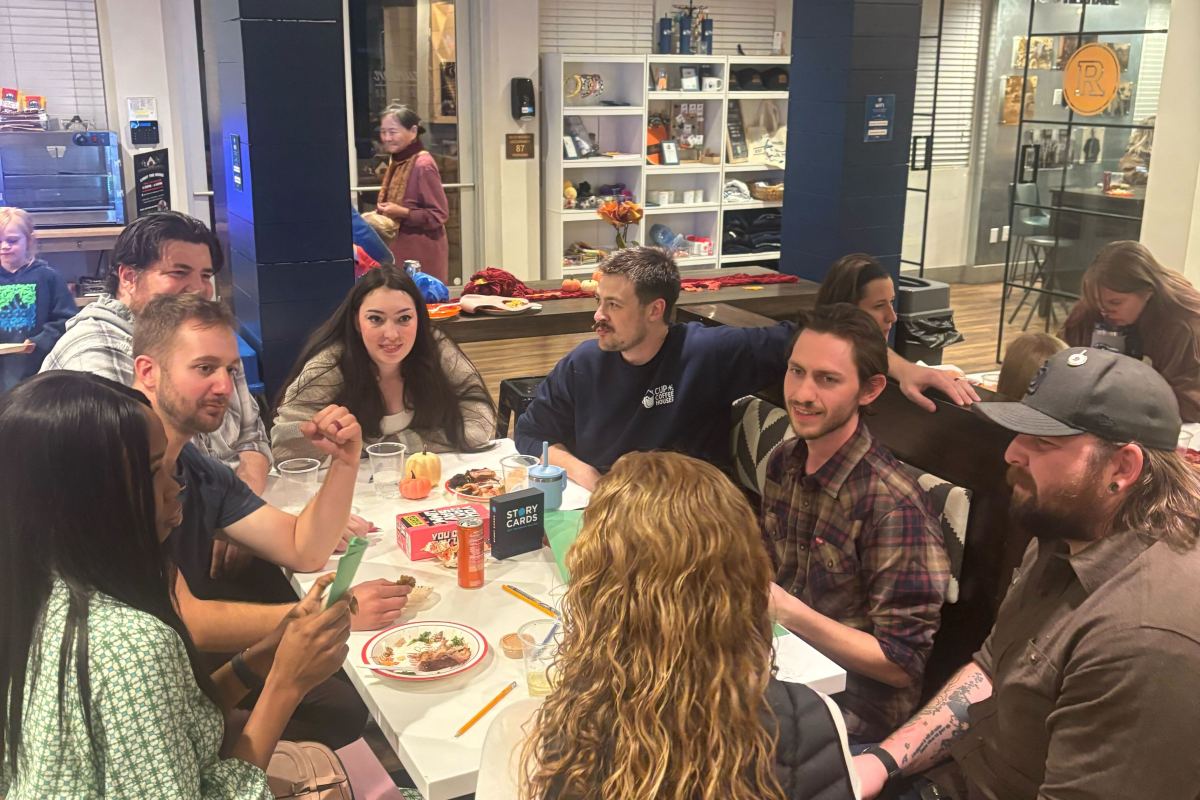
The picture for this blogpost ironically comes from our annul Friendsgiving we do as a church. As you can see by the time Thanksgiving week rolled around, our community was better than ever. There was laughter and joy again, which is always the best company to have around.

People were hesitant to talk during small groups after the message. I think the subject matter of church hurt, the current political climate, and just talking about suffering in general makes everyone uncomfortable. As we were packing up, I overhead one of our teachers question the sexual shame bit, which to be fair is a minority view.

There has been more recent scholarship from the likes of Brent Kinman, Jerome Neyrey, Marika Rose and Katie Edwards, along with others as well. At this time I had incorporated this concept into my own book and relied on work from David Tombs exclusively. I’m a bit on the fence with this specific concept, but I included it simply to challenge our congregation. If you only hear things you agree with, then are you really growing in Christ? Growth is uncomfortable and so too is learning when presented with new ideas.

As for the sermon, I thought I did well with the material overall. I was especially proud of how I included so many solid cross references for this sermon. With that said, Godspeed and Jesus bless.

Genesis: Covenant Confirmed | 11-9-25

Photo Cred: (1) | Updated: 5/14/2026

Sermon Prep

Unlike other sermons we did as a church, this was the first time I had a direct hand in shaping the series itself outside of working with the teaching team to outline said series. Typically Andrew, our lead pastor, outlines and shapes each series himself before running it by the teaching team to tweak. Given the Fall is incredibly busy, especially for him he assigned me to figure out the Joseph section while he mapped out the rest. Since Joseph is one of my favorite figures of the faith, I took on the arduous challenge gladly.

When it came to this teaching though, I didn’t have a lot a lot of prep time. I too was overwhelmed by Halloween Street planning and work, along with Joseph research so I feel like I dropped the ball a bit here getting this one ready. It all worked out, but preferably I like to dedicate the week leading up to a teaching to prep it and I just didn’t do that here. Anyways, here’s the YouTube recording and the notes below:

Sermon Notes

Opening Prayer

  • Father God, lead us this morning as we search the scriptures. Thank you for your Son whose sacrifice is our salvation. Would you speak through me, in spite of me, and beyond me. May you, Holy Spirit, dwell within us as you teach us today. Amen.

Intro

  • Dad promised we’d love Colorado and my family moved there becoming middle class.

Main Point

  • Faith is counted as righteousness because faith rests on God’s fidelity, not human ability.
    • Like Abram trusted God, we too are right with God when we trust his promises.

Covenant Confirmed | Genesis 14:21-15:21 (NRSVue)

[21] Then the king of Sodom said to Abram, “Give me the persons, but take the goods for yourself.” [22] But Abram said to the king of Sodom, “I have sworn to God Most High, maker of heaven and earth, [23] that I would not take a thread or a sandal strap or anything that is yours, so that you might not say, ‘I have made Abram rich.’ [24] I will take nothing but what the young men have eaten and the share of the men who went with me: Aner, Eshcol, and Mamre. Let them take their share.” [1] After these things the word of the Lord came to Abram in a vision, “Do not be afraid, Abram, I am your shield; your reward shall be very great.” [2] But Abram said, “O Lord God, what will you give me, for I continue childless, and the heir of my house is Eliezer of Damascus?” [3] And Abram said, “You have given me no offspring, so a slave born in my house is to be my heir.” [4] But the word of the Lord came to him, “This man shall not be your heir; no one but your very own issue shall be your heir.” [5] He brought him outside and said, “Look toward heaven and count the stars, if you are able to count them.” Then he said to him, “So shall your descendants be.” [6] And he believed the Lord, and the Lord reckoned it to him as righteousness. [7] Then he said to him, “I am the Lord who brought you from Ur of the Chaldeans, to give you this land to possess.” [8] But he said, “O Lord God, how am I to know that I shall possess it?” [9] He said to him, “Bring me a heifer three years old, a female goat three years old, a ram three years old, a turtledove, and a young pigeon.” [10] He brought him all these and cut them in two, laying each half over against the other, but he did not cut the birds in two. [11] And when birds of prey came down on the carcasses, Abram drove them away. [12] As the sun was going down, a deep sleep fell upon Abram, and a deep and terrifying darkness descended upon him. [13] Then the Lord said to Abram, “Know this for certain, that your offspring shall be aliens in a land that is not theirs and shall be slaves there, and they shall be oppressed for four hundred years, [14] but I will bring judgment on the nation that they serve, and afterward they shall come out with great possessions. [15] As for yourself, you shall go to your ancestors in peace; you shall be buried in a good old age. [16] And they shall come back here in the fourth generation, for the iniquity of the Amorites is not yet complete.” [17] When the sun had gone down and it was dark, a smoking fire pot and a flaming torch passed between these pieces. [18] On that day the Lord made a covenant with Abram, saying, “To your descendants I give this land, from the river of Egypt to the great river, the River Euphrates, [19] the land of the Kenites, the Kenizzites, the Kadmonites, [20] the Hittites, the Perizzites, the Rephaim, [21] the Amorites, the Canaanites, the Girgashites, and the Jebusites.”

  • Abram rejects spoils of the sword knowing that God is his shield (Genesis 14:21-15:6).
  • Abram’s deep sleep links to Adam when God acts, while humanity rests (Genesis 15:12).
  • Exodus prophecy ties Abram’s story to Israel’s bigger picture (Genesis 15:13–16).
  • God binds himself by way of a royal grant covenant cutting honor (Genesis 15:17-21).
    • Someone powerful gives an unconditional promise to someone powerless.

Genesis 15 provides an example of a covenant sealed by divine oath. The theophany-ritual described there symbolized the conditional selfmalediction that inheres in the swearing of oaths. To his promise to Abraham God added a second immutable thing. Passing between the slain and divided beasts beneath the threatening birds of prey, God invoked the curse of the oath upon himself should he prove false to it. That curse, so effectively portrayed by the combined ritual and natural features of the scene, was a common one among ancient treaty-curses… By undergoing this ritual God declared in effect that if he failed to fulfill the promises of the covenant, he was like these creatures to be slain and devoured as a feast for the fowls.” –  Meredith G. Kline, By Oath Consigned: A Reinterpretation of the Covenant Signs of Circumcision and Baptism (Grand Rapids, MI: William B. Eerdmans Publishing Company, 1968), 8. Available on meredithkline.com  

Why It Matters

  • Trust grows where promises hold. Therefore we lean on God’s fidelity, not our ability.

Power Text

[5] But to one who does not work but trusts him who justifies the ungodly, such faith is reckoned as righteousness… [13] For the promise that he would inherit the world did not come to Abraham or to his descendants through the law but through the righteousness of faith… [16] For this reason the promise depends on faith, in order that it may rest on grace… not only to the adherents of the law but also to those who share the faith of Abraham… [20] No distrust made him waver concerning the promise of God, but he grew strong in his faith as he gave glory to God, [21] being fully convinced that God was able to do what he had promised. [22] Therefore “it was reckoned to him as righteousness.” [23] Now the words, “it was reckoned to him,” were written not for his sake alone [24] but for ours also. It will be reckoned to us who believe in him who raised Jesus our Lord from the dead, [25] who was handed over for our trespasses and was raised for our justification.” –  Romans 4:5, 16, 20-25 (NRSVue)

  • Faith produces loyal obedience and justification is grounded in God’s promise, not merit.

[13] When God made a promise to Abraham, because he had no one greater by whom to swear, he swore by himself, [14] saying, “I will surely bless you and multiply you.” [15] And thus Abraham, having patiently endured, obtained the promise. [16] Humans, of course, swear by someone greater than themselves, and an oath given as confirmation puts an end to all dispute among them. [17] In the same way, when God desired to show even more clearly to the heirs of the promise the unchangeable character of his purpose, he guaranteed it by an oath, [18] so that through two unchangeable things, in which it is impossible that God would prove false, we who have taken refuge might be strongly encouraged to seize the hope set before us. [19] We have this hope, a sure and steadfast anchor of the soul, a hope that enters the inner shrine behind the curtain, [20] where Jesus, a forerunner on our behalf, has entered, having become a high priest forever according to the order of Melchizedek.” –  Hebrews 6:13-20 (NRSVue)

  • Assurance in God’s promises fuels our endurance in the faith. God’s oath anchors hope.

Outro

  • As a daily holy rhythm, rehearse one promise God has sworn and live from that place.
    • Treat God’s promises as the most concrete and real things about your future.

Final Thoughts

This ended up being a solid sermon and overall my sermons from this series I believe were on another level when compared to previous series because I had such a strong hand in shaping it. Especially the Joseph sermons I did I think worked particularly well. Combining my in-depth series research with typical weeklong sermon prep brought about some unique preaching work on my part I think.

As for this teaching it had some fun improv and off-the-cuff pivots I made mid-preaching. The most notable being the whole section on Luke 8 being ad-libbed. Also except for Eddie, everyone else didn’t get the Shaun of the Dead reference. As a Cornetto Trilogy fanatic, that made me so sad but it’s fine most people don’t appreciate the genius of those films. With that, Godspeed and Jesus bless.

Footnotes

  1. https://opc.org/today.html?history_id=431

Luke: Exit Stage Left | 2-5-2023

Photo Cred: (1) | Updated: 10/12/2024

Sermon Prep

After a month of being at this new job, I was getting the swing of things. It was a lot of work. In hindsight, I never truly felt I got it when it came to this job.

The knowledge-base required was a lot and I just never figured it out to be frank. At the time, I really liked my job but with self-reflection I’ve come to see how much my pride to provide for my family in the midst of a company acquisition had a grip on me. That fearful, fight-flight-freeze framework where I just went after the highest paying job and not what God wanted me to do in my career.

It’s one of those seasons where I don’t know if it was sin, but it was stupid to chase money to provide for my family and save for a house one day. In this season, I was preaching to myself through this series because I was center stage. My efforts and works to will life into a more controlled state versus what it was just a month ago desperately job-hunting afraid of getting fired or let go.

The godly and right thing to do is to step aside and be humble in the presence of Jesus. I don’t have any control of my life. I don’t dictate what happens to my family. And yet, God is always there for us and he will always give us a second chance when we approach him with complete surrender. He makes all things new. With that, here’s the notes for this message.

Sermon Notes

Opening Line

  • Rush at Red Rocks
    • What’s your favorite concert?
    • Who was the opener? The first act?

Intro

  • John the Baptist was the opening act.
    • Jesus was the headliner.
    • Setting the stage for the savior.
  • Exit Stage Left
    • An orderly and uneventful departure, timed so as not to detract or distract.

Transition To Main Point

  • John the Baptist exited stage left, so that Jesus could take center stage.

Main Point

  • Luke 3:1 | Shows Theophilus when this all took place in history (i.e. AD 26-29).
  • Luke 3:2 | The inciting incident
    • Like Old Testament prophets, John the Baptist wandered in the wilderness waiting for the next word of God.
      • See Exodus 3 and 1 Kings 17
  • Luke 3:3-6 | Old Testament fulfillment and symbolism
    • Jordan River = entry to Promised Land
    • Baptism = temple practice of full immersion that took someone from impurity to purity.
    • Taken together, John invites the Hebrews to renew their vows to God as the New Covenant people under grace, not law.
    • This revival set the stage for Jesus.
      • “See the salvation” -> See Jesus
        • Jesus translates to Yahweh saves.
  • Luke 3:7-14 | The Message
    • Salvation is from the shed blood of Jesus, not the sacred blood of Abraham.
      • True repentance is a public confession followed by continued trust in God.
    • Salvation is always belief before behavior.
  • Luke 3:15-17 | The Messiah
    • Mistaken for messiah like Judah the Hammer.
    • Purify the impure that repent of sin.
    • Judge all, but separating people by those who accept grace and those who reject it.
      • Political undertones here too.
  • Luke 3:18-20 | Setting the Stage
    • This was over a good span of time.
    • Herod puts John the Baptist in prison for calling out his divorce to marry his daughter-in-law and Josephus wrote “the great influence John had over the people.”

Why This Matters

  • John exited stage left story-wise, so that Jesus could take center stage next.
    • He’s rarely mentioned after this chapter.
  • Back then like now, the world’s broken.
    • The arrival of Jesus introduces us to a permanent and restorative justice.
  • The topic of baptism invites us to the idea of restarting and having a new beginning.

Final Thoughts

I loved preaching this message and the reason being is that I love John the Baptist! He’s one of the most interesting figures in all of history. Last prophet of the Old Covenant, best friends with Jesus and yet baptizes him, along with being a precursor to the Desert Fathers who would arrive later on in history. I could go on and on about John the Baptist because he just brings a unique insight to both life right before Jesus and right after when Jesus arrives on the scene.

The execution of this message benefitted from my zeal for this topic too. My enthusiasm just beamed from my sermon delivery this Sunday and I remember one of our members mentioning that after the service. Personally, I was also just in a great emotional mood with my Dad flying into town the Thursday after this teaching to spend the weekend with the Colorado family. Anyways, this was one of the good ones. With that, Godspeed and Jesus bless.

Footnotes

  1. Reunion Church

Galatians: Doing Too Much | 7-31-2019

Photo Cred: (1) | Updated: 4-24-2020

[This was a sermon I gave to the youth group at my local church when serving there as a youth leader. It was about 25 minutes and was focused on helping students study the book of Galatians verse-by-verse.]

Introduction

Last week Dan taught on the latter half of Galatians 2. Tonight we will look at the first 9 verses of chapter 3. Let’s read the text and then break down what it means from there.

“You foolish Galatians, who has bewitched you, before whose eyes Jesus Christ was publicly portrayed as crucified? This is the only thing I want to find out from you: did you receive the Spirit by the works of the Law, or by hearing with faith? Are you so foolish? Having begun by the Spirit, are you now being perfected by the flesh? Did you suffer so many things in vain—if indeed it was in vain? So then, does He who provides you with the Spirit and works miracles among you, do it by the works of the Law, or by hearing with faith? Even so Abraham believed God, and it was reckoned to him as righteousness. Therefore, be sure that it is those who are of faith who are sons of Abraham. The Scripture, foreseeing that God would justify the Gentiles by faith, preached the gospel beforehand to Abraham, saying, “All the nations will be blessed in you.” So then those who are of faith are blessed with Abraham, the believer.”

Now this part of Galatians is really split into two main sections. The first half focuses on the bad example of what the Galatians were doing, while the latter half is centered on the good example of what Abraham did differently. The key is that Paul is first addressing the problem that these Christians are dealing with before getting to the solution. What’s the problem? Well, they’re doing too much. Like most of us, they forgot what it means to be a Christian because they added all of this unnecessary filler. Let me explain by focusing on what they got wrong.

Verses 1 – 5

You see, when you first become a Christian, everything is super simple. You know God, He loves you, and all of life seems right for awhile. But then as you get older and the longer you remain a Christian, the more complicated things tend to get. You learn more, you meet different Christians who believe different things, and pretty soon you eventually find yourself wrestling with some new ideas that you’ve never heard of before.

But there’s nothing wrong with learning something new. In fact, Paul himself who wrote Galatians and plenty of other books in the Bible is always encouraging believers to grow in their faith. To mature and go from being infants to mature, seasoned believers who know more about God.

The problem is that most Christians don’t become mature believers over time who know better when a new thing is introduced that may or may not be true. What’s even worse is that we love to be fooled and tricked. Don’t believe me? Watch this (Play magic trick video: https://youtu.be/OVkmibfFbVI).

Honestly, everyone loves to be fooled. We love it. We love movies without knowing how they’re made. We love celebrity couples, even though they are staged. We love drama and gossip, even if it’s not true. We love to be fooled. Combine that with your longing to belong somewhere and that’s where we get this word in verse 1 called bewitched. This word basically means that they were captivated or thoroughly tricked into believing something that is not true.

The Galatians were bewitched into buying the lie that they needed to do more. They took the bait that by adding all this extra fluff to their faith, they were somehow being better Christians. When Paul repeatedly calls them fools in these first 5 verses, he is literally calling them idiots and stupid for believing this lie where they are doing way too much. The Gospel is not I need to do all of these things to show I’m good enough. The Gospel is I can’t do all these things, so God sent Jesus because he is good enough. Ephesians 2:8-10 says, 

“For by grace you have been saved through faith; and that not of yourselves, it is the gift of God; not as a result of works, so that no one may boast. For we are His workmanship, created in Christ Jesus for good works, which God prepared beforehand so that we would walk in them.”

The more you mature as a Christian, the more you realize how much you need Jesus and what little you can do without him. The older we get as believers, the more humble we become as we realize how much it really cost for Jesus to die for our sins. Now let’s look at this guy Abraham.

Verses 6 – 9

Who was Abraham? Well he was a lot of things. He was the ancestor of Jesus, the founder and father of the Hebrew people, along with being a man known for his faith in God. Here, we’re going to look at him and his faith.

For the church in Galatia, Abraham was a big deal. Especially because they were Jewish and Abraham was the father of the Jewish people. So when Paul mentions Abraham, it would be the equivalent of going to China and talking about Jackie Chan. Everybody knew who Abraham was and next Paul is going to bring up why he is so famous in these last 4 verses.

In verse 6, righteousness just means being right with God. Abraham trusted in God and this is what made him right with God. He trusted God for everything. When he moved to a new land and started a whole new nation. When he struggled to have children with his wife and God finally gave them a son. Through it all, Abraham trusted God in the end and that’s why he was considered righteous or right with God.

Anyways, because of this anyone that trusts God is of Abraham. That’s what Paul is trying to get at here in this passage. We trust in God and that means that we are of Abraham, in that we are righteous in God’s eyes. We are right in God’s eyes because we trust in Jesus.

Conclusion

In Philippians 1:6 Paul writes, “For I am confident of this very thing, that He who began a good work in you will perfect it until the day of Christ Jesus.” There is nothing to add to the Gospel. The change that you’ve seen is a result of God working in your life and not the other way around. We might slow down the process when we sin, but we can’t speed it up. Paul writes elsewhere that, “God causes all things to work together for good to those who love God, to those who are called according to His purpose.”

In the end, there really are only two types of Christians. Those who are all about trusting God and those who try to add to what God has done, which shows they trust in themselves more than God. But what God did is done and finished. Don’t try to complete what God started because God is enough for your faith.

This is admittedly a much shorter sermon than usual. It was 3.5 pages versus my more common 4 to 5 page average with double spaced, 12 point font. Think of each page written as 5 minutes when presented. So this message for instance was 17.5 minutes excluding the video. My video example was just over 4 minutes, which meant I had less time to share and therefore shortened my notes to fit the format.

What some of you may have noticed, is that over the past few sermons previously I have mentioned Romans 8:28 to one degree or another. I did this intentionally, so that students could comprehend their own faith with one very compact verse that sums up what we were learning quite well. An overarching theme throughout multiple sermons.

I enjoyed the simplicity of this sermon and it was nice to focus on smaller sections of Scripture, while adjusting to the change of a topical series to a verse-by-verse format for the book of Galatians. It was the original method I learned on how to teach the Bible back in middle school and was fun to go back to for this series. With that, Godspeed and Jesus bless.

Footnotes

  1. www.pexels.com