The Coin Argument

Photo Cred: (1) | Updated: 5/21/2019

I have heard many ask “If God exists, then why is there so much evil in the world?” and there are many responses to this question all throughout history. There are even great Christian thinkers like Alvin Plantinga and Ravi Zacharias who have delivered great responses to this problem of evil. If I was asked this question, here is one way that I would respond and that is with the coin argument.

If God exists, then why is there so much good in the world? The question in its very nature is problematic because it relies on a partial-variable. It depends on the assumption that God and evil cannot both exist.

If this assumption is true, then God and good cannot both exist. Thus, leaving the universe amoral, which we all know is a flawed and true conclusion. It is true based off of basic deductive reasoning from our previous premises, yet flawed because evil and good are both quite evident in our universe.

For examples of evil look no further than the horrors of war, famine, pestilence, natural disasters, and the like. For instances of good look no further than the sacrificial love of a mother for her child, giving to those that are in need, treating others the way you want to be treated, and so on. The existence of evil and good is too evident in the world to ignore.

Let me use an analogy to further my point: let’s say I have a coin. You say that if I flip this coin 100 times with it landing on heads every single time in a row, then there must be no coin maker. Now I say if I flip this coin 100 times with it landing on tails every single time in a row, then there must be a coin maker. Let’s surmise that such a scenario occurs where you’re right: the coin lands on heads 100 times in row. Does your conclusion logically make sense that there is no coin maker? No and neither would mine any more so than yours because it is focused on the coin’s mathematical probability of landing on heads or tails. When the focus should shift to “where did we get the coin in the first place?”

That’s the root issue here. Where do objective moral values come from in the first place? For the sake of time, objective moral values will be abbreviated to OMV. In my analogy, the coin represents OMV and likewise each side of the coin represents one side of those OMV (heads = objectively negative moral values -> “evil” and tails = objectively positive moral values -> “good”).

Therefore, as is the case with all things there must be an objective standard to determine what are objectively negative moral values (evil) and what are objectively positive moral values (good). This objective standard can only be 4 things: from something less than myself [nature](1), from something equal to myself [individual](2), from others equal to myself [society](3), or from something greater than myself [God](4).

Now, how am I obligated by something less than me [nature](1) to obey these OMV? There’s no need to be obligated by nature since nature is beneath mankind. Why should I lower my standards to comply with values of nature? When something within nature kills it is survival of the fittest, yet when we kill it is murder. So, should I obligate myself [individual](2) to these OMV? Do I have that absolute authority? If so, I myself can remove that absolute authority if I want to, which throws out the second conclusion all together making it obsolete.

Then can others [society](3) obligate me to OMV? Why does the majority have that absolute authority over the minority (myself)? How does a single variable like majority vs. minority suddenly change who can enforce OMV? If there is a society that can, then which one? And if there is one, what happens when that society eventually crumbles like every society before it has in the past? Thus, this objective standard must be greater than myself [God](4) because it (He) is superior to me and can rightfully demand obedience to these OMV as He is greater than I.

Hence, evil and good can only exist if there is a set of OMV determined by an objective standard [God](4) that can enforce these OMV onto us. This is the most logical and reasonable conclusion. God as the objective standard gives us the ability to discern what is evil and good. Without Him, nothing is sin while everything is live and let live. With that, Godspeed and Jesus bless.

Footnotes

  1. https://www.pexels.com/

Gideon Part 2: The Hero’s Journey Begins

Photo Cred: (1) | Updated: 5/21/2019

The first installment of “Gideon, Get’ Em!” focused on the general background of the book of Judges and set the stage for God to raise up the next judge of Israel: Gideon. This time, we meet the hero of our series. The chosen one if you will that God appoints to do His will in saving the Israelites from certain death. Without jumping too far ahead, let’s read the text for this portion of the series.

“Then the angel of the LORD came and sat under the oak that was in Ophrah, which belonged to Joash the Abiezrite as his son Gideon was beating out wheat in the wine press in order to save it from the Midianites. The angel of the LORD appeared to him and said to him, “The LORD is with you, O valiant warrior.” Then Gideon said to him, “O my lord, if the LORD is with us, why then has all this happened to us? And where are all His miracles which our fathers told us about, saying, ‘Did not the LORD bring us up from Egypt?’ But now the LORD has abandoned us and given us into the hand of Midian.” The LORD looked at him and said, “Go in this your strength and deliver Israel from the hand of Midian. Have I not sent you?” He said to Him, “O Lord, how shall I deliver Israel? Behold, my family is the least in Manasseh, and I am the youngest in my father’s house.” But the LORD said to him, “Surely I will be with you, and you shall defeat Midian as one man.” So Gideon said to Him, “If now I have found favor in Your sight, then show me a sign that it is You who speak with me (NASB Judges 6:11-18).””

There is a lot to go over in this passage. Let’s start with the simple stuff, then progress from there. References to “the angel of the LORD” are Christophany moments. A Christophany is an Old Testament appearance of Jesus the Christ and this is when Jesus is physically present in history. This occurs a few times in the Old Testament (2). These are also a foreshadowing of later on in history when the Word became flesh (3) and paid the debt of humanity by atoning for all the sins of mankind.

It’s always awesome to see God interact with His creation in such interesting ways, yet at the same time in ways that the people of that time could relate too. For Joshua, a soldier, God appeared as a soldier. For Jacob (4), He appeared as a man busting Jacob’s hip in a wrestling match. Living under the New Covenant, we too interact with God in ways that on a person-to-person basis, makes sense to us.

When I got saved and came to Christ, I was compelled by the way the Bible was written as a storyteller reading the ultimate story. I was so enthralled by God’s Word when I became a believer that I read the entire book of Genesis the night of my conversion. It was so enthralling! To see the greatest storyteller unveil just a snippet of His master plan was exciting to say the least reading it for the first time.

Although no one living today is apart of the A-Story found in the Bible, we all are apart of the B-Story in history, otherwise known as history or His-Story. The A-Story is a film term referring to the journey the protagonist takes during the duration of a film. The B-Story is the side story that at first, seems unrelated to the A-Story, until it’s tied together at the end of the film with the A-Story. That’s what we are right now. Chugging along through our own B-Stories waiting to enter Heaven and see where our story fits alongside God’s A-Story.

It’s a very interesting time to be in because we look back at the A-Story revealed so far (the Bible, excluding Revelation & the prophecies to be fulfilled, history/the past, etc.) and then look at our own B-Stories, feeling useless in the grand scheme of things. It honestly is really hard sometimes because it’s like we’re on the sidelines learning about “real Christians” like King David and John the Baptist who did incredible things in God’s A-Story. But rest assured, God promises in His Word that all things will be worked together for those that follow Christ (5). Just remain faithful in living out your B-story and one day God will reveal your essential role in His A-Story when we enter His Kingdom.

Something else of note in this passage is how we are introduced to our hero of our story. It’s the perfect example of the humble-beginnings type of hero. Gideon is found serving his household diligently beating his wine-press, in order to hide wheat from the clutches of the Midianites. I like how bible-history.com describes this moment as the following: “Gideon, in order to avoid being seen by the Midianites, beat out his wheat in a wine-press instead of threshing it on the threshing-floor,” which is not usual because in those times someone would thresh the floor, not beat the winepress. In other words, Gideon was scared out of his mind and arguably should be with the life he has being so insignificant in the grand scheme of things from his perspective. The Midianites were going to take all that they could consume, so he tried to hide it from them.

Gideon is the Luke Skywalker of this story: a nobody going nowhere in life. Or so he thought. He was the youngest son in his family (v15), of a family of little to no name in society or Israel for that matter (v15), is most likely tired of living out his B-Story compared to past mighty people of God who had great triumphs (v13), and has doubts when it comes to miracles (v13). It’s understandable that Gideon would complain to the LORD about his B-Story when the A-story looks so awesome.

Little did he know that his B-Story was about to become an essential part of the A-Story. You see in the kingdom of God, the bench-warmers are the starters and the starters are the bench-warmers. God loves to use the foolish in the world’s eyes to shame the wise of this world (6). It’s kind of God’s favorite method: using the broken to fix a broken world. So too, Gideon is our broken protagonist who God has chosen as the centerpiece vessel for His plan of redemption for Israel. What happens next in this encounter is the first few steps in the master plan from the master.

The LORD comes to Gideon in verse 12 and starts the conversation with “The LORD is with you, O valiant warrior.” As if Gideon was some valiant warrior to begin with, which he was not, and the following conversation between the two seems to imply this truth. Just on a side note, it’s always interesting when God will call someone by what they will be one day as if they already are this position or title. Since our timelines are linear and God is outside of time, he can look at our entire timeline, instead of us who only see the pieces of the past or present. So from God’s point of view, Gideon is a valiant warrior. He just does not know it yet.

Back to the text, Gideon responds with basically “God, you left us and now we’re doomed. What happened to all of those promises you said you would keep and the things you did for us in the past” (v13)? At this point in time, Gideon seems quite frustrated and afraid of the future believing the worst is to come for Israel. But God has other plans, so He presses with His proposed plan: “Gideon, you’re the chosen one. I picked you to save Israel. Go as you are to do My will” (v14). Then Gideon wines like a Skywalker about how unprepared he is to do God’s will (v15), so the LORD replies with “Dude, I’m God. They will lose” (v16). Next, Gideon is like “Alright God, if it’s really you, then show me somehow. Please stay, so that I can build you something cool and then show you my cool thing” (v17). The LORD ends the conversation with “Yeah, sure thing Gideon.”

Now that’s my own paraphrase of their conversation, but you get the idea. God wants to use Gideon. Gideon wants to water his dirt farm. God tells him to stop being a dweeb. Gideon listens to God and goes to get some power-converters. You get the jist of it. So Gideon heads out to go and prepare this offering for God, while God stays around for the offering. Come back next time as we observe what happens next in the life of Gideon as his B-Story ends and his A-Story begins. With that, Godspeed and Jesus bless!

Footnotes

  1. Star Wars (1977)
  2. Genesis 18:1-33, Joshua 5:13-6:5
  3. John 1:1
  4. Genesis 32:22-30
  5. Romans 8:28
  6. 1 Corinthians 1:26-29
  7. Disclaimer

Gideon Part 1: Setting the Stage for the Savior

Photo Cred: (1) | Updated: 5/21/2019

When I say “Bible Heroes,” who comes to mind? Daniel? Esther? Samson? You know, those historical figures that did mighty things for the LORD and are praised for their amazing courage in Scripture. Well for now, forget about those peeps because today we are going to look at one of the more underrated figures of the Bible: Gideon. This 12-part blog series will be a study on the life, death, and legacy of Gideon. A man whose impact was so far reaching in the Bible that he is praised by the author of the book of Hebrews as a man of faith who served God diligently, but we’ll get to that later. For now, let’s look at some historical details to set the stage for this first installment in this series.

About The Author

The majority of Gideon’s story is written in the book of Judges in the Bible. The author of Judges is most likely the Prophet Samuel, but that’s not for certain and is only attributed to Samuel because of the oral Jewish tradition. Although the case can be made that it was a collaborative effort (2). The author would have to be someone who lived just after this period in history, about 1045-1000 B.C. and Samuel the Prophet fits this bill the best. Also of note, “the Book of Ruth was originally a part of the Book of Judges, but in A.D. 450 it was removed to become a book of its own” (3). So the author of Judges may have also been the author of the Book of Ruth.

Background & Culture

The book of Judges is the Mad Max of the Bible and the time of the Judges was kind of insane. There was outright anarchy, rebellion, violence, and all other things of that nasty sort happening everywhere you went. Then every once in awhile, God would handpick someone to be a judge and do His will in drawing His chosen people back to Him. Whether that be Deborah or Samson, God would pick out some nobody to do something absolutely magnificent, in order to bring God’s people back to Himself. Israel at this time was a wreck and broken from the inside by sin, as well as on the verge of war by opposing nations seeking to annihilate them permanently.

As the book of Judges says itself, “In those days there was no king in Israel; everyone did what was right in his own eyes (4).” Rightly so, because the people of Israel rejected God and went their own way towards sin. This time period could be compared to an emergency room where one goes to die, yet lives. Where death and life clash. Where eternity and time cross paths. Often the times of Judges was a continual back and forth of resuscitation. Where Israel would spiritually die, God would resuscitate them, and then they would experience spiritual revival. This is where we start our study in the life of Gideon. Israel is dead and needs God, so God decides to use Gideon to get’em back to being alive in Him.

“Then the sons of Israel did what was evil in the sight of the LORD, and the LORD gave them into the hands of Midian seven years. The power of Midian prevailed against Israel. Because of Midian the sons of Israel made for themselves the dens which were in the mountains and the caves and the strongholds. For it was when Israel had sown, that the Midianites would come up with the Amalekites and the sons of the east and go against them. So they would camp against them and destroy the produce of the earth as far as Gaza, and leave no sustenance in Israel as well as no sheep, ox, or donkey. For they would come up with their livestock and their tents, they would come in like locusts for number, both they and their camels were innumerable; and they came into the land to devastate it. So Israel was brought very low because of Midian, and the sons of Israel cried to the LORD.” (NASB Judges 6:1-6)

Notice how Israel is always in this continuous cycle of dependency for God and in-dependency from God. How in the previous chapter, “the land was undisturbed for forty years” (5), completely dependent on God’s mercies and now after merely a generation are back to their evil ways. In chapter 6 we come to the second half of this vicious cycle of humanity’s relationship to God and His mercies: the independent stage. It’s a very dangerous stage. Full of volatile lifestyles and chaotic consequences on humanity’s part as God eagerly awaits to save His precious nation.  

So because of this rebellion, God allows the Midianites to completely wreck the lands of Israel. The Midianites and Amalekites were Arabian nomad races: groups of people that wandered for resources with no homeland. They were from the east (modern day Middle East) and would continuously raid Israel of all its resources until they were full and then leave, while the Israelites would take shelter in caves, mountains, or strongholds to avoid conflict. Since their numbers were too many and the Israelites were no match for such mighty people groups like the Midianites and Amalekites, this series of raids went on for seven long years.

It’s usually during times of war when one finds out what they are made of in the face of extreme circumstances. Whether that be physical, mental, or spiritual, warfare is the ultimate way of revealing one’s true character. Or in this case, the character of the nation of Israel: afraid and resistant to conflict. They showed their true colors. They let their enemies take anything they desired as they sat back in fear. It was probably embarrassing for those who lived during the days of deliverance when Deborah and Barak faithfully did God’s will, which led to ending the tyranny of Jabin the king of Canaan just forty years ago (6). But Israel in their time of trouble finally cried out to God and God, in the following verses of Chapter 6, replies with some scathing words of correction and comfort.

“Now it came about when the sons of Israel cried to the LORD on account of Midian, that the LORD sent a prophet to the sons of Israel, and he said to them, “Thus says the LORD, the God of Israel, ‘It was I who brought you up from Egypt and brought you out from the house of slavery. I delivered you from the hands of all your oppressors, and dispossessed them before you and gave you their land, and I said to you, “I am the LORD your God; you shall not fear the gods of the Amorites in whose land you live.” But you have not obeyed Me.”’”” (NASB Judges 6:7-10)

The sons of Israel were guilty for committing sin against God by disobeying His laws and doing their own thing. Now they are rightfully repenting of their sins and believing in the saving grace of God. In response to their turning away from sin, God sends a prophet to speak on His behalf and speaks to the people of Israel. In His response as spoken through the prophet, God essentially says “Did you forget who I am? What I’ve done for you? How I saved you from back in the day?” Even when Israel was again in rebellion towards God, He still spares them and keeps His promises. A key theme in the book of Judges is God’s ability keep His promises and the inability of mankind to listen to Him.

Although they have rightly repented and turned back to God, sin has long-lasting consequences that are harder to get rid of than the actual sin. In this case, the Amorites and the Midianites are back in the picture. The next step is for Israel to remove the their enemies who are destroying God’s chosen people. But how? They’re no match! The Israelites have nothing compared to the massive forces of the Amorites and the Midianites. Well, God has a plan of redemption and it begins with the heroes journey of one specific man: Gideon. With that, Godspeed and Jesus bless!

Footnotes

  1. Mad Max: Fury Road (2015)
  2. 1 Chronicles 29:29
  3. http://www.gotquestions.org/Book-of-Judges.html
  4. Judges 21:25
  5. Judges 5:31b
  6. Judges 4:4-6, 23-24
  7. Disclaimer

Why I Am Not A Calvinist

Photo Cred: (1) | Updated: 5/21/2019

 In the first installment of my “Why I Am” series, I will be giving three brief reasons as to why I do not adhere to the Judeo-Christian school of thought known as Calvinism. As I have studied and read about Calvinism, there have been many sources I have used to write this blog-post. Some of these sources were Norman Geisler’s sermon called “Why I Am Not a 5 Point Calvinist” (2), George L. Bryson’s book on Calvinism (3), and Tim Stratton’s 4-part series “The Petals Drop” on his website (4). There were other resources, but these were the main three that inspired me to write this blog-post.

So what is Calvinism exactly? Calvinism is a type of Christian doctrine created in the 16th Century by the French Theologian John Calvin to answer how God’s Sovereignty and Humanity’s Free Will coexist together. There are five main parts to Calvinism. According to gotquestions.org (5), Calvinism can be summarized by the acronym TULIP and is defined as the following:

  1. Total Depravity: “Every aspect of humanity is tainted by sin; therefore, human beings are unable to come to God on their own accord.”
  2. Unconditional Election: “God elects individuals to salvation based entirely on His will, not on anything inherently worthy in the individual.”
  3. Limited Atonement: “Jesus only died for the elect.”
  4. Irresistible Grace: “When God calls a person to salvation, that person will inevitably come to salvation.”
  5. Perseverance of the Saints: “A person who is elected by God will persevere in faith and will not permanently deny Christ or turn away from Him.”

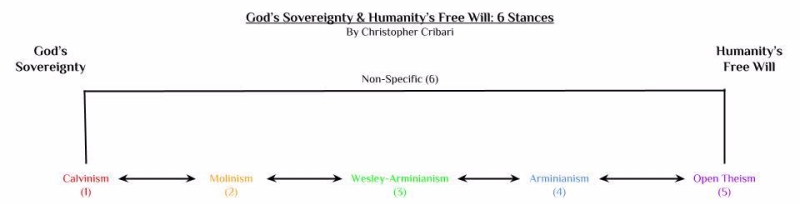
In other words, a Calvinist is a Christian that sees everything with an over-emphasis on God’s Sovereignty, which entails either a deterministic or compatibilistic philosopical view of the world. Here is a quick illustration that I made to put into perspective where Calvinism stands in the grand spectrum of the issue of God’s Sovereignty vs. Humanity’s Free Will within Christianity:

God's Sovereignty & Humanity's Free Will- 6 Stances

One last thing is that when I refer to a Calvinist or Calvinism, I am referring to a 5-Point Calvinist. Not those that claim to be any combination that is short of a 5-Point Calvinist like a 4-Point Calvinist or a 2-Point Calvinist. But the whole point of the 5 points of Calvinism is that they are supposed to work together like the pillars to a building. By removing one point you fracture the legitimacy of the other four points and the foundation of Calvinism in general because they were designed by John Calvin to work together, not to work independently of each other. With that said, let’s look at my objections and see why I am not a Calvinist.

1) Calvinism is Great Exegesis Without Hermeneutics

In general, with the Calvinistic perspective on Scripture, there are massive misinterpretations of certain passages within the Bible. Most notably, Scriptures such as Romans chapters 9-11, John chapter 6, Ephesians 1:1-4, and the list goes on. In contrast, there are Scriptures like 1 John 2:2, Romans 1:16-17, or 1 Timothy 2:3-6 that explicitly go against Calvinism. Put simply, context is key and exegesis without context is like a madman with a sword.

2) Calvinism Makes Sharing the Gospel Logically Incoherent

If you think about the Gospel from the Calvinist perspective, Jesus only came to save the elect, only the elect will go to Heaven, and only the elect will get saved. So then sharing the Gospel becomes useless and pointless because those who are predestined to go to Heaven will go to Heaven and those who are predestined to go to Hell will go to Hell, while at the same time you have no say in the matter.  As Bryson put it in his book, The Five Points of Calvinism, “You will be saved or damned for all eternity because you were saved or damned from all eternity.” (Bryson, 121). Although some of the most prominent preachers have been Calvinists like Charles Spurgeon, their actions are not logically consistent with determinism. It is the equivalent of preaching to tombstones because no matter what some people are just doomed to damnation because it somehow glorifies God.

3) Calvinism Makes God the Author of Evil

If God is completely sovereign, then from the Calvinistic perspective God is the author of evil because He brought it into existence. This goes against everything that characterizes God as worthy of worship and completely good. How can a perfect being bring about imperfection? Only through the Calvinistic perspective is this possible because God is the cause of everything that exists including evil, instead of Eve and Lucifer bringing sin into God’s creation by going against God in their own free will. Philosopher William Lane Craig on the subject of Calvinism once said “according to this view (causal determinism and compatibilism), the way in which God sovereignly controls everything that happens is by causing it to happen, and freedom is re-interpreted to be consistent with being causally determined by factors outside oneself (6).”

So since God is ultimately the first cause of everything, God is therefore the author of evil and good. Something that is completely contradictory to the Bible and Judeo-Christianity as a whole. There are even Calvinist’s that affirm that God is the author of evil. People like R.C. Sproul Jr. affirm this idea of God being the author of evil several times throughout his book (7) that deals with this issue.

Now these are just 3 of many objections I have to Calvinism and are just reasons as to why I do not affirm to be Calvinist. Other objections I have include sin being excusable or God lying to people in the Bible, but that would take awhile to explain every objection I have to Calvinism, so for the sake of time I only chose 3 objections. Hopefully, this helps you with understanding this issue and maybe one day you can decide where you stand on the issue of how God’s Sovereignty and Humanity’s Free Will interact together. My advice for those of you do not understand this issue quite yet is to just believe what the Bible affirms: 1) that God is Sovereign and 2) that humans have Free Will. This is the safest stance concerning this issue because it is strictly Biblical avoids the gridlock nature of philosophical schools of thought like Calvinism among others. With that, Godspeed and Jesus bless!

Footnotes

  1. https://restorethegospel.wordpress.com/2009/11/19/a-conversation-about-calvinism-and-arminianism/
  2. https://youtu.be/fPpkSiO1Ci
  3. The Five Points of Calvinism, George L. Bryson
  4. http://freethinkingministries.com/the-petals-drop-why-calvinism-is-impossible/
  5. https://www.gotquestions.org/Calvinism-vs-Arminianism.html
  6. http://www.reasonablefaith.org/molinism-vs-calvinism
  7. http://www.reclaimingthemind.org/blog/2008/09/taking-calvinism-too-far-rc-sproul-jr%E2%80%99s-evil-creating-deity/http://amzn.to/2xM4F1Q
  8. Disclaimer