The Value of Time

Photo Cred: (1) | Updated: 5/21/2019

Time. It is the most valuable resource in the universe and in life. As Charles Darwin put it, “A man who dare waste one hour of time has not discovered the value of life.” Time is a mysterious thing.

What Is Time?

It is not quite like other resources, such as water or oxygen because it is not limited by the boundaries of space. In fact, it does not actually inhabit any space or  physical matter like water or oxygen. Time is simply here, but is hard to comprehend sometimes why it is here. Some argue that time is its own dimension or reality.

Why is the universe limited by an ever increasing range of numbers that eventually will stop when God decides that it is time for a new earth and a new heaven (2)? Why even place this limit upon the universe? Why didn’t God just create an eternal universe, instead of a transient universe? Why is time so valuable you might add?

Unlike water or oxygen, time can never be stored or saved for later. Time is ever ending. It’s like a bowl of sand being poured out slowly, but surely until the bowl is completely empty. Once the bowl is empty, that’s it. Time has run out. As scary as that sounds, that is the reality of time.

Another way of understanding time is that it is like throwing a stone or firing a gun at a specific target. Both the bullet and the stone will travel for awhile at various rates of speed before colliding with the target, thus ending their course. Time is like the distance the bullet and the stone travel. The “trigger-man” so to speak is God and He caused everything into being, which includes the starting point of time and the endpoint.

Then again, is time even linear to begin with in the first place? Some say time is linear, while others propose it is cyclic like a cone (i.e. the Big Bang Model), along with a few that say it may even be an ever expanding sphere of sorts (i.e. a balloon being blown up). Now I’m no scientist, so I cannot determine which view is correct. What I can do is present each theory briefly to help us better understand time.

For the traditional view of time, that camp argues that there was a first cause. Since that first cause, there has been a sequential series of events moving on a horizontal plane to an unknown end. Think like a ruler or a simple line with two end points.

In the cyclic (cone) group of thinkers, they presume that time is a lot like the way people understand the universe in that both are expanding in the shape of a cone. There was a starting point where the first cause occurred, but since then it has been expanding. These thinkers use the phenomena of red-shift stretching across space as proof of this theory.

The third camp does likewise in that they use red-shift as evidence for their view, but to a different extent. They argue that time is a lot like a big ball that is slowly growing in size until it finally pops. An easy example would be to refer to the way oxygen fills up a balloon until it explodes. In a way, they believe time is a swirling twirl of cause and effect colliding in an incomprehensible pattern that is interwoven like a ball of yarn. A chaotic masterpiece.

Why do I bring up these various ideas of time? Because I want you to know how much we do not understand about time. How much we barely know. How much we as human beings under-appreciate time and undervalue it. Life’s most valuable resource.

What Does The Bible Say About Time?

The Bible, God’s inspired Word, has a lot to say concerning the concept of time. The actual word “time” appears in the NASB translation of the Bible 626 times. To say that time is important to God is an extreme understatement. Some passages of Scripture that come to mind would be Ecclesiastes chapter 3 where King Solomon reflects on the concept of time and seasons. In the chapter, he asserts that “there is an appointed time for everything.” Essentially, every single moment in time matters. There are no coincidences, but only opportunities. With this in mind, nothing can be random because something caused those “random” moments.

Time is a lot like the wind. We cannot actually see it, but we can observe its effects on our environment. Time is an effect-full, yet invisible force of nature that guides everything within the universe, including the universe itself.

Time is also like a loan from God. When God first created the universe, a countdown was started. From that point onward, time has been counting down to the moment when the universe ends. With this in mind, everything within the universe also has a beginning, a middle, and an end. We are born, live our lives hopefully to the fullest, and then die. It is the cycle of everything in the universe.

Because we are limited by time, we are also on a countdown to our own inevitable end. Eventually, our time here in the material realm will be done as we transition into the spiritual realms of either Heaven or Hell. If you adhere to the Naturalist worldview, then this is it and you have nothing to look forward to after death. Those who hold to a theistic worldview can look forward to a better or worse eternity. For the Naturalist, nothing. Even in this life there is nothing. From the Naturalist’s worldview, you have no meaning, purpose, or value.

Now let’s observe the other position. That there is meaning, purpose, and value because there is something beyond the material as the theistic worldview asserts. Where does this meaning, purpose, and value come from? Just as the meaning, purpose, and value of a work of art comes from the artist giving their artwork these qualities, we too find these same things in God.

Since we derive our meaning, purpose, and value from God it would only make sense that those must be fulfilled in this life. I mean why would God instill these desires in our hearts, if not to see us follow His plans for our lives and satisfy these desires within our lifetimes? C.S. Lewis once spoke of this predicament when he said “Creatures are not born with desires unless satisfaction for these desires exists” (3).

The question remains: how do we fulfill these desires and how does this tie back into the value of time? Well, let’s go back to what the Bible has to say on the topic of time in a bit more detail. This will clue us in on how to appropriately answer this question in a way that is both emotionally and logically reasonable. If time is a variable in which we are contingent on, then how do we use it to our benefit to satisfy our ultimate desires? In the book of Exodus, reflection and remembrance is a key theme that carries throughout this book in the Old Testament of the Bible.

Specifically, Exodus 13:10-14 where the LORD instructs the Hebrews on how they are to reflect and remember how God delivered them from the land of Egypt by taking them to the Promised Land. This aspect of reflecting and remembering time is also of note in Exodus chapter 34 where an entire chapter is dedicated to this idea of remembrance, particularly Exodus 34:21 where the Hebrews are commanded by God to rest. The key lesson here is that there is a time and a place for everything. God formulated this philosophy when He created the universe by spending six days working and one day resting. Thus, fulfilling what we would call the work week.

Next, we jump to Nehemiah 2:6 where we can use time as a measurement to map out our lives or God can for that matter (4). Yet at the same instant, be men and women of our word. Nehemiah did this when he gave King Artaxerxes, accompanied by the Queen, a definite time of when he would return. A promise was proclaimed.

There are “God-Moments” when God enters time and accomplishes His will for His glory by allowing us free agents to bring about these so-called “God Moments” (5). Time can peel away inner heartache that can unveil who we are or what we have become (6). Time is a witness of the past (7) and is always brimming with opportunity (8) for us to fulfill our God-given desires.

Final Thoughts

How do I spend my time? Good question. How should I spend my time? Better question. If time is a loan from God, then how much time has God given me? No one knows. I don’t know and you don’t know. That is what makes this life so interesting and so risky. Our time is set, yet we are not informed of how much time is set.

That is why we must use our time wisely, in order to make the most of the time we are given from God. We must redeem the time (9) as we wait expectantly for the appointed time to be fulfilled and remain alert for that to pass (10). We use our time wisely when we set out to fulfill the God-given desires of our hearts by abiding in Christ, which will in turn satisfy our craving for ultimate meaning, purpose, and value.

Love your loved ones. Fellowship with friends. Work hard and do not become sluggish in what may end up being your final moments. The past grows as the future shrinks, so this is the time to seek God. This life that you and I live is an ever ending marathon. A journey one might say that is not over until we enter eternity.

This is just a brief summary of why I uphold the value of time and treasure it far above anything that this life can offer. How will we use this gift? What will we do with our time? Well, that’s up to you. With that, Godspeed and Jesus bless!

Footnotes

  1. https://www.pexels.com/
  2. 2 Peter 3:10-13; Revelation 21:1-5
  3. Mere Christianity (bk. 3, chap. 10)
  4. Exodus 9:5; Psalm 75:2; Daniel 2:16
  5. Judges 16:28
  6. Job 36:10, 15
  7. Isaiah 30:8
  8. John 7:6
  9. Ephesians 5:16
  10. Mark 1:15; 13:33

Gideon Part 2: The Hero’s Journey Begins

Photo Cred: (1) | Updated: 5/21/2019

The first installment of “Gideon, Get’ Em!” focused on the general background of the book of Judges and set the stage for God to raise up the next judge of Israel: Gideon. This time, we meet the hero of our series. The chosen one if you will that God appoints to do His will in saving the Israelites from certain death. Without jumping too far ahead, let’s read the text for this portion of the series.

“Then the angel of the LORD came and sat under the oak that was in Ophrah, which belonged to Joash the Abiezrite as his son Gideon was beating out wheat in the wine press in order to save it from the Midianites. The angel of the LORD appeared to him and said to him, “The LORD is with you, O valiant warrior.” Then Gideon said to him, “O my lord, if the LORD is with us, why then has all this happened to us? And where are all His miracles which our fathers told us about, saying, ‘Did not the LORD bring us up from Egypt?’ But now the LORD has abandoned us and given us into the hand of Midian.” The LORD looked at him and said, “Go in this your strength and deliver Israel from the hand of Midian. Have I not sent you?” He said to Him, “O Lord, how shall I deliver Israel? Behold, my family is the least in Manasseh, and I am the youngest in my father’s house.” But the LORD said to him, “Surely I will be with you, and you shall defeat Midian as one man.” So Gideon said to Him, “If now I have found favor in Your sight, then show me a sign that it is You who speak with me (NASB Judges 6:11-18).””

There is a lot to go over in this passage. Let’s start with the simple stuff, then progress from there. References to “the angel of the LORD” are Christophany moments. A Christophany is an Old Testament appearance of Jesus the Christ and this is when Jesus is physically present in history. This occurs a few times in the Old Testament (2). These are also a foreshadowing of later on in history when the Word became flesh (3) and paid the debt of humanity by atoning for all the sins of mankind.

It’s always awesome to see God interact with His creation in such interesting ways, yet at the same time in ways that the people of that time could relate too. For Joshua, a soldier, God appeared as a soldier. For Jacob (4), He appeared as a man busting Jacob’s hip in a wrestling match. Living under the New Covenant, we too interact with God in ways that on a person-to-person basis, makes sense to us.

When I got saved and came to Christ, I was compelled by the way the Bible was written as a storyteller reading the ultimate story. I was so enthralled by God’s Word when I became a believer that I read the entire book of Genesis the night of my conversion. It was so enthralling! To see the greatest storyteller unveil just a snippet of His master plan was exciting to say the least reading it for the first time.

Although no one living today is apart of the A-Story found in the Bible, we all are apart of the B-Story in history, otherwise known as history or His-Story. The A-Story is a film term referring to the journey the protagonist takes during the duration of a film. The B-Story is the side story that at first, seems unrelated to the A-Story, until it’s tied together at the end of the film with the A-Story. That’s what we are right now. Chugging along through our own B-Stories waiting to enter Heaven and see where our story fits alongside God’s A-Story.

It’s a very interesting time to be in because we look back at the A-Story revealed so far (the Bible, excluding Revelation & the prophecies to be fulfilled, history/the past, etc.) and then look at our own B-Stories, feeling useless in the grand scheme of things. It honestly is really hard sometimes because it’s like we’re on the sidelines learning about “real Christians” like King David and John the Baptist who did incredible things in God’s A-Story. But rest assured, God promises in His Word that all things will be worked together for those that follow Christ (5). Just remain faithful in living out your B-story and one day God will reveal your essential role in His A-Story when we enter His Kingdom.

Something else of note in this passage is how we are introduced to our hero of our story. It’s the perfect example of the humble-beginnings type of hero. Gideon is found serving his household diligently beating his wine-press, in order to hide wheat from the clutches of the Midianites. I like how bible-history.com describes this moment as the following: “Gideon, in order to avoid being seen by the Midianites, beat out his wheat in a wine-press instead of threshing it on the threshing-floor,” which is not usual because in those times someone would thresh the floor, not beat the winepress. In other words, Gideon was scared out of his mind and arguably should be with the life he has being so insignificant in the grand scheme of things from his perspective. The Midianites were going to take all that they could consume, so he tried to hide it from them.

Gideon is the Luke Skywalker of this story: a nobody going nowhere in life. Or so he thought. He was the youngest son in his family (v15), of a family of little to no name in society or Israel for that matter (v15), is most likely tired of living out his B-Story compared to past mighty people of God who had great triumphs (v13), and has doubts when it comes to miracles (v13). It’s understandable that Gideon would complain to the LORD about his B-Story when the A-story looks so awesome.

Little did he know that his B-Story was about to become an essential part of the A-Story. You see in the kingdom of God, the bench-warmers are the starters and the starters are the bench-warmers. God loves to use the foolish in the world’s eyes to shame the wise of this world (6). It’s kind of God’s favorite method: using the broken to fix a broken world. So too, Gideon is our broken protagonist who God has chosen as the centerpiece vessel for His plan of redemption for Israel. What happens next in this encounter is the first few steps in the master plan from the master.

The LORD comes to Gideon in verse 12 and starts the conversation with “The LORD is with you, O valiant warrior.” As if Gideon was some valiant warrior to begin with, which he was not, and the following conversation between the two seems to imply this truth. Just on a side note, it’s always interesting when God will call someone by what they will be one day as if they already are this position or title. Since our timelines are linear and God is outside of time, he can look at our entire timeline, instead of us who only see the pieces of the past or present. So from God’s point of view, Gideon is a valiant warrior. He just does not know it yet.

Back to the text, Gideon responds with basically “God, you left us and now we’re doomed. What happened to all of those promises you said you would keep and the things you did for us in the past” (v13)? At this point in time, Gideon seems quite frustrated and afraid of the future believing the worst is to come for Israel. But God has other plans, so He presses with His proposed plan: “Gideon, you’re the chosen one. I picked you to save Israel. Go as you are to do My will” (v14). Then Gideon wines like a Skywalker about how unprepared he is to do God’s will (v15), so the LORD replies with “Dude, I’m God. They will lose” (v16). Next, Gideon is like “Alright God, if it’s really you, then show me somehow. Please stay, so that I can build you something cool and then show you my cool thing” (v17). The LORD ends the conversation with “Yeah, sure thing Gideon.”

Now that’s my own paraphrase of their conversation, but you get the idea. God wants to use Gideon. Gideon wants to water his dirt farm. God tells him to stop being a dweeb. Gideon listens to God and goes to get some power-converters. You get the jist of it. So Gideon heads out to go and prepare this offering for God, while God stays around for the offering. Come back next time as we observe what happens next in the life of Gideon as his B-Story ends and his A-Story begins. With that, Godspeed and Jesus bless!

Footnotes

  1. Star Wars (1977)
  2. Genesis 18:1-33, Joshua 5:13-6:5
  3. John 1:1
  4. Genesis 32:22-30
  5. Romans 8:28
  6. 1 Corinthians 1:26-29
  7. Disclaimer

Gideon Part 1: Setting the Stage for the Savior

Photo Cred: (1) | Updated: 5/21/2019

When I say “Bible Heroes,” who comes to mind? Daniel? Esther? Samson? You know, those historical figures that did mighty things for the LORD and are praised for their amazing courage in Scripture. Well for now, forget about those peeps because today we are going to look at one of the more underrated figures of the Bible: Gideon. This 12-part blog series will be a study on the life, death, and legacy of Gideon. A man whose impact was so far reaching in the Bible that he is praised by the author of the book of Hebrews as a man of faith who served God diligently, but we’ll get to that later. For now, let’s look at some historical details to set the stage for this first installment in this series.

About The Author

The majority of Gideon’s story is written in the book of Judges in the Bible. The author of Judges is most likely the Prophet Samuel, but that’s not for certain and is only attributed to Samuel because of the oral Jewish tradition. Although the case can be made that it was a collaborative effort (2). The author would have to be someone who lived just after this period in history, about 1045-1000 B.C. and Samuel the Prophet fits this bill the best. Also of note, “the Book of Ruth was originally a part of the Book of Judges, but in A.D. 450 it was removed to become a book of its own” (3). So the author of Judges may have also been the author of the Book of Ruth.

Background & Culture

The book of Judges is the Mad Max of the Bible and the time of the Judges was kind of insane. There was outright anarchy, rebellion, violence, and all other things of that nasty sort happening everywhere you went. Then every once in awhile, God would handpick someone to be a judge and do His will in drawing His chosen people back to Him. Whether that be Deborah or Samson, God would pick out some nobody to do something absolutely magnificent, in order to bring God’s people back to Himself. Israel at this time was a wreck and broken from the inside by sin, as well as on the verge of war by opposing nations seeking to annihilate them permanently.

As the book of Judges says itself, “In those days there was no king in Israel; everyone did what was right in his own eyes (4).” Rightly so, because the people of Israel rejected God and went their own way towards sin. This time period could be compared to an emergency room where one goes to die, yet lives. Where death and life clash. Where eternity and time cross paths. Often the times of Judges was a continual back and forth of resuscitation. Where Israel would spiritually die, God would resuscitate them, and then they would experience spiritual revival. This is where we start our study in the life of Gideon. Israel is dead and needs God, so God decides to use Gideon to get’em back to being alive in Him.

“Then the sons of Israel did what was evil in the sight of the LORD, and the LORD gave them into the hands of Midian seven years. The power of Midian prevailed against Israel. Because of Midian the sons of Israel made for themselves the dens which were in the mountains and the caves and the strongholds. For it was when Israel had sown, that the Midianites would come up with the Amalekites and the sons of the east and go against them. So they would camp against them and destroy the produce of the earth as far as Gaza, and leave no sustenance in Israel as well as no sheep, ox, or donkey. For they would come up with their livestock and their tents, they would come in like locusts for number, both they and their camels were innumerable; and they came into the land to devastate it. So Israel was brought very low because of Midian, and the sons of Israel cried to the LORD.” (NASB Judges 6:1-6)

Notice how Israel is always in this continuous cycle of dependency for God and in-dependency from God. How in the previous chapter, “the land was undisturbed for forty years” (5), completely dependent on God’s mercies and now after merely a generation are back to their evil ways. In chapter 6 we come to the second half of this vicious cycle of humanity’s relationship to God and His mercies: the independent stage. It’s a very dangerous stage. Full of volatile lifestyles and chaotic consequences on humanity’s part as God eagerly awaits to save His precious nation.  

So because of this rebellion, God allows the Midianites to completely wreck the lands of Israel. The Midianites and Amalekites were Arabian nomad races: groups of people that wandered for resources with no homeland. They were from the east (modern day Middle East) and would continuously raid Israel of all its resources until they were full and then leave, while the Israelites would take shelter in caves, mountains, or strongholds to avoid conflict. Since their numbers were too many and the Israelites were no match for such mighty people groups like the Midianites and Amalekites, this series of raids went on for seven long years.

It’s usually during times of war when one finds out what they are made of in the face of extreme circumstances. Whether that be physical, mental, or spiritual, warfare is the ultimate way of revealing one’s true character. Or in this case, the character of the nation of Israel: afraid and resistant to conflict. They showed their true colors. They let their enemies take anything they desired as they sat back in fear. It was probably embarrassing for those who lived during the days of deliverance when Deborah and Barak faithfully did God’s will, which led to ending the tyranny of Jabin the king of Canaan just forty years ago (6). But Israel in their time of trouble finally cried out to God and God, in the following verses of Chapter 6, replies with some scathing words of correction and comfort.

“Now it came about when the sons of Israel cried to the LORD on account of Midian, that the LORD sent a prophet to the sons of Israel, and he said to them, “Thus says the LORD, the God of Israel, ‘It was I who brought you up from Egypt and brought you out from the house of slavery. I delivered you from the hands of all your oppressors, and dispossessed them before you and gave you their land, and I said to you, “I am the LORD your God; you shall not fear the gods of the Amorites in whose land you live.” But you have not obeyed Me.”’”” (NASB Judges 6:7-10)

The sons of Israel were guilty for committing sin against God by disobeying His laws and doing their own thing. Now they are rightfully repenting of their sins and believing in the saving grace of God. In response to their turning away from sin, God sends a prophet to speak on His behalf and speaks to the people of Israel. In His response as spoken through the prophet, God essentially says “Did you forget who I am? What I’ve done for you? How I saved you from back in the day?” Even when Israel was again in rebellion towards God, He still spares them and keeps His promises. A key theme in the book of Judges is God’s ability keep His promises and the inability of mankind to listen to Him.

Although they have rightly repented and turned back to God, sin has long-lasting consequences that are harder to get rid of than the actual sin. In this case, the Amorites and the Midianites are back in the picture. The next step is for Israel to remove the their enemies who are destroying God’s chosen people. But how? They’re no match! The Israelites have nothing compared to the massive forces of the Amorites and the Midianites. Well, God has a plan of redemption and it begins with the heroes journey of one specific man: Gideon. With that, Godspeed and Jesus bless!

Footnotes

  1. Mad Max: Fury Road (2015)
  2. 1 Chronicles 29:29
  3. http://www.gotquestions.org/Book-of-Judges.html
  4. Judges 21:25
  5. Judges 5:31b
  6. Judges 4:4-6, 23-24
  7. Disclaimer

The Lovely Trinity Argument

Photo Cred: (1) | Updated: 5/21/2019

This blog-post is a little different than past blog-posts in that I will be showing you briefly my first argument for the Christian Trinity. My argument is called “The Lovely Trinity Argument” and was heavily inspired by the works of C.S. Lewis, especially his arguments in Mere Christianity. The argument resides on the central question found in premise seven and is actually what I asked myself a few years ago when the original concept for the argument began to take shape in my mind. Shout out to my friend, Kevin King, for helping me fine-tune my argument to make it as logically airtight as possible. Here is the argument down below presented in a premise-by-premise structure like almost all other philosophical arguments:

The Lovely Trinity Argument

By Christopher Cribari

  1. Before Creation, there was God (✝).
  2. God was alone and nothing existed, except for God before Creation.
  3. Therefore, God is the objective standard for all things pertaining to morality and the like, including love because He is all that existed.
  4. Thus, God is love (✝), love is God*, and God is all-loving.
  5. Love is an action expressed towards an object.
  6. Love is actively expressed from person to person.
  7. But if God is love, love is God, and God is all-loving, who would God love?
  8. A Unitarian God cannot love Himself because He is one person.
  9. Thus, God would need to be 2 or more than 2 persons to actively express love, in order for God to be love, for love to be God, and for God to be all-loving.
  10. Therefore, God is one being (✝), but multiple persons.
  11. But in order for love to be expressed for others to see, there has to be a third party or person.
  12. Thus, a Binitarian God cannot love another person without a third party or person to validate that love.
  13. Therefore, God is one being, but three persons (✝).
  14. Hence, the doctrine of the Trinity is true because it validates that God is love, love is God, and God is all-loving, while at the same time affirming that God is triune.
  15. For God is a Trinitarian God: one being, but three persons.

Argument Footnotes

* = C.S. Lewis penned “love is God” in his work, Mere Christianity, in chapter 4 of book 4 entitled “Good Infection.”

✝ = Biblical References

  • Premise 1) Genesis 1:1, Hebrews 1:10
  • Premise 4) 1 John 4:8, 16
  • Premise 10) Deuteronomy 6:4, 1 Timothy 2:5a
  • Premise 13) 2 Corinthians 13:14

Well, that is my argument for the Christian Trinity and I hope it helps you wherever you are in relation to God. If you would like to hear my newer argument for the Christian Trinity, click here. With that, Godspeed and Jesus bless!

Footnotes

  1. Free stock photos · Pexels
  2. Disclaimer

Why I Am An Avid Reader

Photo Cred: (1) | Updated: 5/21/2019

With the new year having just begun, it’s interesting how so many hold onto the idea of starting fresh, even though it’s simply another day of life. How this change in years can cause people to make these pledges of how they will make changes in direction in their lives. Changes like losing weight, being a better spouse, paying off debt, etc. In the spirit of this season of making commitments for the new year, I would like to give my own commitment for the new year.

Along with that, I also want to address why I am an avid reader and why you should be too. But first let me share with you three different true stories revolving around the importance of books and reading. In Pastor Jon Courson’s daily devotional, A Pillar By Day, he writes of an interesting exchange between two men of immense power in the ancient world, in it he writes:

“A story is told in the Mishnah (a collection of Jewish teachings and writings) of a certain Persian king named Arteban who sent to Judah, the prince of Jerusalem, the largest diamond in existence. Upon receiving this gift, Judah sent back to Arteban a copy of the book of Deuteronomy with the accompanying note: What you sent me requires guards to protect it. What I have sent you will guard and protect you (P. 360).”

The night of May 10th, 1933 is a night few can forget. Adolf Hitler and his minister of propaganda, Joseph Goebbels, held a nationwide book burning across 34 university towns in Germany. They burned 25,000 total books by fellow Nazi-influenced university students as they held the Nazi salute (2). Books included, but were not limited to works by Albert Einstein, Helen Keller, and even at the end of the ceremony, copies of the Bible were burned last. It was a night where the existence of free thought was challenged by those indoctrinated by the Nazi agenda. Individuals who were dependent on the thoughts of a tyrant that limited learning to what was deemed politically correct at the time.

John Lennox, a Professor of Mathematics at Oxford University, grew up in Northern Ireland in a Christian upbringing by his parents during the 1940s and 1950s in Armagh. His father, a Christian man, taught him that one ought to know what they believe before they learned what others believed. So he read what he could on Christianity, which included the Bible as often as possible throughout his childhood. His father then taught him that in order to avoid being one sided and biased in his beliefs, he should read what others have to say coming from different belief systems to be a more rounded individual. So his father gave him a copy of The Communist Manifesto by Karl Marx and told him to read it.

The reason I share these three stories is to show how important reading is in the life of anyone willing to learn. Why it’s so crucial to learn by listening and reading what others have to say on a matter, whatever that matter may be. With the first story showing the value of reading is worth more than the greatest diamond the world can offer, the second story showing the cost of reading the ideas of others that some might disagree with, and the right to know what you believe, as well as what others believe.

Is it any wonder why nearly every dictator or tyrant in history has removed books from the public? As the old saying goes, knowledge is power. It’s absolutely critical to be an avid reader because in reality, there might possibly be no better way to learn something than to simply read.

Various studies show that reading has immense benefits like the following:

  1. Improves Analytical, Memory, Writing, & Vocabulary Skills.
  2. Reduces Stress.
  3. Prevents Alzheimer’s and Dementia.

Of course, these are not the only benefits, but are the most profound effects that reading can have on the human condition. It’s a little ridiculous as to how beneficial reading really is and how it helps make you a more rounded individual. For me, it aids me in comprehending and understanding the world I inhabit, while at the same time providing me with answers to life’s greatest questions. It’s easily one of the most useful skills that one can use on a day-to-day basis. But in an age of social networking, it has been left to die out with each new generation.

Admittedly, I’m not one to talk because I too neglect the power of reading. Yet because it’s a new year I have made a promise to myself and to others to read at the very least 10 books. Not just any ten books though, but specifically these 10 books:

  1. The Sacred Search by Gary Thomas
  2. Mere Christianity by C.S. Lewis
  3. Till We Have Faces by C.S. Lewis
  4. My Utmost For His Highest by Oswald Chambers
  5. The Real Kosher Jesus by Michael L. Brown
  6. Rise by Trip Lee
  7. Why Suffering by Ravi Zacharias & Vince Vitale
  8. Against the Flow by John C. Lennox
  9. Warranted Christian Belief by Alvin Plantinga
  10. Rebel With A Cause by Franklin Graham

Now I have already finished reading The Sacred Search, which was great and have started Mere Christianity, which is also great. So at this point I’m at a great pace. Of course to some this may seem like a lot, but if you think about it, it’s basically a book a month. Actually closer to a month and a week per book.

That’s 5 weeks to read one book. That is very doable. In fact I challenge those of you who do not usually read books to make a list of 10 books and try to read them in a year. Or you could make a list of 12 books and read a book a month to challenge yourself. All I’m saying is that you should something to test your mind and keep it fit by simply reading books. Whether that’s just one book a year or 365 books a year, it’s up to you. Nevertheless, my challenge to you is to read 10 books.

To all of my avid readers out there, I know what you’re thinking: “Chris, why is your list so short?” Well, in reality, I was never just going to just read 10 books this year. This was merely the starting point of my 2016 reading list and these were just the first 10 books that I wanted to read.

Since I have made my list, it has grown to about 25 books for the year, which amounts to basically a book every 2 weeks. Not exactly lightning fast, but a good amount that’s manageable for me. And again, everyone has their own speed that they can read a book.

I know for some a book a month is a struggle, while I know others that can read a book in a day. For instance, growing up Dr. Ben Carson and his brother would read 2 books a week because his mother wanted them to get out of their poverty stricken lives in Detroit, Michigan by educating themselves. Needless to say, they are both very successful individuals, whether or not you agree with everything they believe.

The bottom line is, what are you waiting for? Get out there and learn for crying out loud! Educate yourself or entertain yourself with some truly amazing books waiting to be read. Whether they be historical, fictional, or comedic, any book will due.

The point is that I am an avid reader and you should be too because every benefit outweighs every detriment to reading books. So why not start this year with a positive change that will greatly impact you by taking time to crack open a book and learning something new? The choice is up to you. With that, Godspeed and Jesus bless!

Footnotes

  1. https://www.pexels.com/
  2. http://www.pbs.org/wgbh/amex/goebbels/peopleevents/e_book.html
  3. Disclaimer

An Argument For Apologetics: Part II

Photo Cred: (1) | Updated: 5/21/2019

Since this is apart of a blog-post series, let me briefly remind you of what I have already gone over in Part I of my argument for apologetics. In the first post in this series, I defined faith, described apologetics, and went over my first point on why we need apologetics in Christianity. That point being that it is pre-evangelism. The way I argued this was with a knight allegory, but I will instead use an expression used at the film school I attend to make the point clearer.

When it comes to film, it really boils down to 2 things: knowing your audience and knowing your story. Relating this back to the topic at hand, apologetics is about knowing your story, while evangelism is about knowing your audience. Let me quickly explain what I mean by that.

Apologetics is all about understanding on a logical and technical level who you’re, what you believe, and how to appropriately answer any objections to Christianity. Evangelism is all about understanding on a moral and spiritual level who someone is, what is holding them back from the cross, and how to appropriately guide them to the cross. Both are equally relevant and dependent on each other in outreaches to the world. Whether that’s a missions trip, feeding the homeless, street witnessing, etc. As my Dad once said, “Apologetics is pre-evangelism and if it’s not, you’re doing it wrong.”

2) Apologetics Saved the Church From Heresy

In A.D. 325, there was the Council of Nicaea and this meeting brought church leaders from the East and the West together to discuss a series of current Christian topics at hand. These topics included, but were not limited to the calendar date of Easter, defining the Trinity, and the nature of Jesus Christ. The latter being the most prominent topic of the meeting because it was debated by two opposing forces within the church at the time.

One side of this debate was Arius the priest who thought that Jesus was not eternal, but created. He was literally punched in the face for this heretical claim during the proceedings by Bishop Nicholas. The other side of the debate was led by Deacon Athanasius and Bishop Alexander who argued the biblical stance of Jesus being eternal like God the Father. The whole council, which consisted of hundreds of bishops and other prominent Christian leaders, watched as one of the most important debates in Christianity took place over one of the most central truths of Christianity: Jesus is God.

It was a debate that had so much riding on it: the future of Christianity, the foundation of the church, and so much more. The emperor of Rome, Constantine, resided over the proceedings looking to end the division in the church, which he thought would end political division within the Roman Empire, only added to the tension. It was the debate of the century. After much back and forth, a vote was taken and the vast majority agreed with Bishop Alexander and Deacon Athanasius that Jesus is God. Arius was eventually expelled as a heretic from the church, along with Arianism altogether.

Why do I bring this up? Because it is instances like this where large opposition has risen against the church, usually from within the church, and without the use of apologetics, would have destroyed the church. Another time where this has happened was the Protestant Reformation. This was when Martin Luther boldly left the Catholic church, which had seriously deviated from correct biblical truth, to bring them back from their heretical claims. Such as the Pope’s word was equal in measure to God’s Word (the Bible) in authority.

So the greatest Christian church split in history happened. It was a time when apologetics was absolutely necessary to defend the Christian faith from those who had twisted it. Other instances when apologetics saved the skin of the church from either destruction from the outside or manipulation from the inside were the following: the rise and fall of Gnosticism, the Enlightenment when the church was under attack from the intellectuals of the time, or even today with the rise of Prosperity Theology, otherwise known as the Faith Movement.

Every generation of the church body has had its heresies, cults, false religions, and worldly belief systems to deal with that help the body of Christ stay alert. This “always be ready” mentality of confronting heresies head-on with apologetics to protect the flock of God from falling away is essential to continual growth in Christ. Some notable apologists who defended the Christian worldview are Gottfried Wilhelm Leibniz (The Cosmological/Contingency Argument, invented binary language), Rene Descartes (The Origin of the Idea of God Argument, invented the cartesian coordinate system), and Blaise Pascal (Pascal’s Wager, invented the first working mechanical calculator).

These men were also the fathers of modern philosophy and science, who still impact the culture with their use of apologetics centuries later. As was once said in a lecture at Rice University by Professor John Lennox, “Far from being a hindrance to science, belief in God was the motor that drove it.” In short, without apologetics Christianity would not be where it is today because of those bold enough in the faith to protect others from the deceit of the Devil, the world, and even our own corrupt selves.

3) Apologetics Builds Up the Church

If you do not know why you believe what you believe, why believe? This is the motivating question behind my apologetics passion and why I care so much for it. I strongly believe in the fact that every believer needs to not only know what they believe, but to know why they believe it in the first place. Christianity is not led by blind faith, but is led by bold faith. But this faith is not bold because of blind passion like followers of other worldviews.

Rather, it is because we know what we believe to be true, which causes the believer to understand certain things like the fear of God, the compassion of Christ, and that there are billions of people living today who are not ready for the return of Christ. It’s an abundance of emotions to know God, while at the same time know how few know God. It’s sad and joyous all at the same time. It’s the motor that drives the believer to distant lands all across the globe or to local rough parts of town in our cities. We are driven by the burden of the broken to mend them with the good news of the Gospel.

But with this burden for the broken comes questions from the broken that wish to be built back up, yet are afraid of being broken again. How can the broken be reassured that what you have and offer from God is any different from say Islam, Buddhism, or any other belief system with the same exact claims? Claims of fulfilling meaning, purpose, and value? This is when apologetics is to be appropriately used in defending the Christian worldview by differentiating it from other worldviews. This in turn builds up the believer at the same time as reassuring their broken spirit.

Apologetics not only defends against outward opposition and intense inquiry, but also from inward doubts and fears. One fear that used to cloud my mind early in my faith was ‘How do I really know that God exists? Is what I am experiencing really a supernatural experience that I can personally interact with God or just my feelings overcoming my emptiness for relevance in life?’

Eventually, I came to the same conclusions that the late C.S. Lewis came to in his lifetime. That for every desire, there exists a satisfaction for these desires of ultimate meaning, purpose, and value. This is better known as The Desire Argument famously made by Lewis in his book, Mere Christianity.

There was also the fact that the universe screams for a necessary, intelligent, mindful, personal, first-cause that could conceive of the universe itself. This was my starting point as to why I believed in the existence of God and has helped me when going through times of doubt or times of spiritual struggle. Knowing God is always there is something that I always find comfort in and helps me cope with the harder times in life as I bet it does for other believers as well.

You see, apologetics builds up the church by reinforcing the spiritual connection the believer has with Jesus with logical and relevant facts to support such an ambitious relationship. I mean, how many people really understand the uniqueness of interacting with God on a day-to-day basis worldwide? Not many because it sounds too strange at first to accept, but in reality is far from it.

That dynamic with God really starts when we admit we are wrong and He is right. It’s so simple it boggles the minds of the greatest skeptics around the world! Lunacy to some to even consider they could be wrong or better yet, indebted to God.

The more you learn in the realm of apologetics, the more you appreciate and understand your relationship with God. Things like how the persons of the Trinity interact, essential doctrines that define the specifics of certain aspects to Christianity, and the list goes on. It’s encouraging to know that I know what I believe in and then to have even more joy when sharing that faith with others because I fully grasp what I am sharing. It’s logical substance fueled by fiery passion equaling a great servant of God. Apologetics is meant to build the body of Christ up, not tear it down.

Just as a mother tells their child to put on their coat to protect themselves from the weather, so too you ought to put on the shield of apologetic faith to protect yourself from the horrors of spiritual warfare. In so doing, the church in general is built up knowing that whatever comes opposing truth can be deflected with that same truth.

Basically, every Christian should know a little apologetics because God commands us to in 1 Peter 3:13-16, in order to further the Gospel. In that passage, the Apostle Peter writes that we should give a defense for the hope that is in us. So above all else, the believer needs to know apologetics and use apologetics because God commands us too in His Word, in order to further the expansion of the kingdom.

To end, here are some great resources in no particular order that you can use to sharpen your apologetics utility belt in furthering the message of the Gospel, as well as strengthen your own faith:

  1. On Guard by William Lane Craig
  2. Handbook of Christian Apologetics by Peter Kreeft and Ronald K. Tacelli
  3. Mere Christianity by C.S. Lewis
  4. Know What You Believe by Paul E. Little
  5. Christian Apologetics by Norman L. Geisler
  6. Essential Truths of the Christian Faith by R.C. Sproul
  7. Jesus Among Other Gods by Ravi Zacharias

Of all of these resources, I recommend Paul E. Little’s book, Know What You Believe, the most because it covers everything the Christian absolutely needs to know in detail without the extra baggage. It’s short and covers everything the Christian absolutely needs to know about their faith. Highly recommended resource and it’s one book I turn to often to sharpen my faith. With that, Godspeed and Jesus bless!

Footnotes

  1. https://wikipedia.com
  2. Disclaimer

An Argument For Apologetics: Part I

Photo Cred: (1) | Updated: 5/21/2019

In recent years, there has been a rise in the claim that apologetics is no longer necessary in Christianity. Well, I disagree with that notion and here’s why: apologetics is a quintessential aspect to the life of every Christian. It is the shield, so to speak, that the believer stands behind and gives a defense of the faith from, with, and through. There is a reason that when Paul the Apostle mentions the armor of God (2), he refers to the shield, as a shield of faith. And that is exactly what apologetics is in the tool belt of the believer: a shield. As Professor John Lennox of Oxford University said in a dialogue with Richard Dawkins, “My faith is a faith of evidence.”

In another lecture he quipped that “Faith is a response to evidence, not a rejoicing in the absence of evidence.” Put succinctly, the Christian faith is on the higher ground right from the get go compared to every other belief system in world history. Apologetics is merely quintessential to the Christian faith because it a) reveals this higher ground and b) shows you how to defend this higher ground from all who look to capture the flag of victorious truth that rests on Calvary hill. Like the author of the book of Hebrews put it, “Now faith is the substance of things hoped for, the evidence of things not seen (3).”

The word apologetics is derived from the combination of the word ‘apologetic’ meaning to give “a formal defense” in Middle French and the suffix ‘ics’ for “nouns that denote a body of facts, knowledge, principles, etc.” (4). But to be more specific, apologetics is the “the branch of Christianity that deals with the defense and establishment of the Christian faith” (5). With all of this in mind, here are 3 reasons why apologetics is necessary for every Christian.

1) Apologetics Is Pre-Evangelism

Have you ever seen a medieval knight charge into battle against an opposing force? Put more bluntly, if an opposing knight is charging towards you with their sword preparing to strike you down, how would you counter their attack? With your sword or with your shield? The obvious answer should be to deflect the sword with the shield and then proceed with your own sword to strike back.

This analogy is the relationship of apologetics and evangelism in a nutshell: apologetics is the shield and evangelism is the sword of Christianity. But the problem with those who misuse apologetics is twofold: they either use the sword (evangelism) first or they just use the shield (apologetics) without using the sword (evangelism). Let me explain the problem with both of these tactics.

Let’s start with the first tactic: using the sword first. Now at first glance, going out to preach the gospel seems simple enough. I mean who really needs apologetics, right? Plenty can get done with just a sword! Well, let’s set the spiritual battleground with a simple story. 

You’re on a train going to the big game tonight. There are hundreds of people on the train wearing their team’s jersey and excitingly talking about the game. Now you being a believer, overhear a heated conversation between a New Atheist and a devout Hindu who just so happen to be in the same section as you on the train. 

The two are discussing the idea of God and whether or not belief in God, or as the Hindu would argue, many gods makes logical sense. In fact, there are about 330 million gods according to the devout Hindu. So you being an active believer, burdened with the work of the ministry, jump politely into the conversation in order to win them to the faith (6).

At first everything seems fine. You’ve prayed beforehand, you’re well versed in the Scriptures, and you’re humbly listening before engaging in the conversation. Hearing what the discussion is about before you present your worldview. Then it happens: your turn to speak. So you being a cheerful giver, give them the gospel, but there’s one problem. Neither see the need for the gospel. Now what do you do? 

Well, you stumble a little over your words and begin to reiterate how much God loves them and has this wonderful plan for their life! How much Jesus loves them! Neither seem the least bit interested, laugh at your little love speech about a Middle Eastern man, and continue with their conversation without you.

Now what? You then in a fury, spew Bible verse after Bible verse of how Jesus is God! Yes, this must work! Nothing. Absolute zero attention is paid to your poetic spewing. So you, in utter defeat, walk away embarrassed and mad. What happened? Let me explain.

You see, using the knight analogy, you kept using your sword when you should have been using your shield. As a matter of fact, you were using your sword as both the shield and the sword, causing you to be spiritually exhausted because you had only offense as an option. No time to counter correctly or to pause on an important point like the existence of God, which was the original conversation the two were having in the first place. Remember, the New Atheist doesn’t believe in God and the devout Hindu believes in many gods, so without addressing that topic you have no firm footing in this fight.

Now let’s try a different option, using only the shield. So the same scenario, but you are an apologetics nut. You know every argument, every counter-argument, and every rebuttal. So you boldly go into the discussion without any fear because you know how to defend the faith. And after a little back and forth you finally convince both the New Atheist and the devout Hindu that there is only one God. But now you come across your first hurdle. Why does that matter? 

Sure, they now believe in a single God, but where do you go from here? What was the point of proving that there was a God in the first place? So then the conversation quickly dies off and goes back to simple things like the big game tonight. What did you do? How did this happen? You knew everything! Or so you thought. Let’s go back to the knight analogy.

You’re going to war, but you decide to only take your shield and leave your sword behind. Do you see the problem? By only taking the shield, you can only survive the war intact, instead of ending the war intact. You can only deflect opposition without ending opposition. Eventually you’ll be too tired from blocking the opposing knight’s attacks that they will kill you by simply fighting until you are exhausted. Or in the case of the train story, you’ll eventually just go back to simpler things because you knew no way out. 

How sad is this? That you can disarm your opponent, but cannot finish them? Yet that is the reality of those who only use apologetics in outreaches or ministry. They deflect the accusations of the mind, without getting to the heart of the issue. And the other tactic of just using the sword to cut to the heart of the issue without addressing the logical issues of the mind is also unuseful. Both are foolish ways to enter the spiritual battleground because a true knight of God is well equipped with a shield and a sword.

Now let’s see what happens when you bring both your shield and sword to the battle. Again, same scenario, but this time you’re prepared in all aspects that matter: spiritually, mentally, etc. First you use the shield, deflecting every fiery arrow with logical and truthful answers. It works and neither the New Atheist nor the devout Hindu has a shield anymore.

Now is the time to strike with the double edged sword. Their mind is ready, but the heart is not. This is the time to finish their seeds of doubt by driving the sword of spiritual truth through them. So you being a faithful steward, drive the point home with the sword of evangelism. The end result? Two new believers in Christ. Well, in this train story at least.

There will be times when people do not come to faith in Jesus. Not because you didn’t do your part in sharing the truth, but they didn’t do their part in accepting the truth. Your job as a believer is to share the truth with others, but how they react to the message is not up to you. That’s up to them and God from that point on. How exactly did this work? Because the tools at your disposal were used properly for what they were designed to do: reach the lost by sharing what has been found in Christ.

Although I use very blunt analogies with knights to describe the relationship between apologetics and evangelism, that does not mean that you should be mean or rude towards whoever you’re reaching out too. Far from it! I am speaking in spiritual terms when I speak of the war terminology and this shouldn’t actually spill over into actual witnessing. Just something to keep in mind to help with witnessing. Understanding that you’re in a spiritual war, not a physical or verbal war with the lost that you’re reaching.

Remember, these are tools that the believer should use together when at an outreach, but they do not always have to use them together. There will be times where simple evangelism will bring someone to the cross or vice versa with apologetics. The reason I argue that they should be used together is because most of the time people have a spiritual wall that is blocking them from a relationship with Jesus. So the walls need to come down before the real evangelism can work. 

But the Holy Spirit works in mysterious ways, so don’t take this as factual, but more as suggested when outreaching to the world. Then again this approach can be seen used by Jesus (7), Paul the Apostle (8), Stephen (9), Peter (10), and so on. Usually this is a combination of apologetics and evangelism, not a simple one-two punch when outreaching. More of a back and forth dynamic when talking to others with civility and respect.

But without love, none of this information matters. You’ll be nothing but sounding brass speaking to the lost, yet not reaching the lost (11). As Ravi Zacharias once said, “Love is the greatest apologetic. It is the essential component in reaching the whole person in a fragmented world.” In the Gospel of Matthew, Jesus is quoted saying “‘You shall love the LORD your God with all your heart, and with all your soul, and with all your mind.’ This is the great and foremost commandment. The second is like it, ‘You shall love your neighbor as yourself.’ On these two commandments depend the whole Law and the Prophets (12). “

You have to have a loving heart for the lost in order to be effective for the work of the ministry. It is the single greatest aspect in the life of the Christian. Just as Jesus did, you too have to have a heart for the harvest (13). So to put it sufficiently, apologetics is pre-evangelism and only works when done in love. Come back next time for Part 2 of this series, which delves into my second point: how apologetics saved the church from heresy. With that, Godspeed and Jesus bless!

Footnotes

  1. https://www.deviantart.com/pandarice/art/knights-mounted-fight-32834504
  2. Ephesians 6:16
  3. Hebrews 11:1 (NKJV)
  4. https://dictionary.reference.com
  5. https://carm.org/apologetics
  6. 1 Corinthians 9:19-27
  7. Luke 24:13-35
  8. Acts 17:1-15
  9. Acts 7:1-53
  10. Acts 2:14-42
  11. 1 Corinthians 13:1-3
  12. Matthew 22:35-40 (NASB)
  13. Matthew 9:35-38
  14. Disclaimer

Why I Am Not A Calvinist

Photo Cred: (1) | Updated: 5/21/2019

 In the first installment of my “Why I Am” series, I will be giving three brief reasons as to why I do not adhere to the Judeo-Christian school of thought known as Calvinism. As I have studied and read about Calvinism, there have been many sources I have used to write this blog-post. Some of these sources were Norman Geisler’s sermon called “Why I Am Not a 5 Point Calvinist” (2), George L. Bryson’s book on Calvinism (3), and Tim Stratton’s 4-part series “The Petals Drop” on his website (4). There were other resources, but these were the main three that inspired me to write this blog-post.

So what is Calvinism exactly? Calvinism is a type of Christian doctrine created in the 16th Century by the French Theologian John Calvin to answer how God’s Sovereignty and Humanity’s Free Will coexist together. There are five main parts to Calvinism. According to gotquestions.org (5), Calvinism can be summarized by the acronym TULIP and is defined as the following:

  1. Total Depravity: “Every aspect of humanity is tainted by sin; therefore, human beings are unable to come to God on their own accord.”
  2. Unconditional Election: “God elects individuals to salvation based entirely on His will, not on anything inherently worthy in the individual.”
  3. Limited Atonement: “Jesus only died for the elect.”
  4. Irresistible Grace: “When God calls a person to salvation, that person will inevitably come to salvation.”
  5. Perseverance of the Saints: “A person who is elected by God will persevere in faith and will not permanently deny Christ or turn away from Him.”

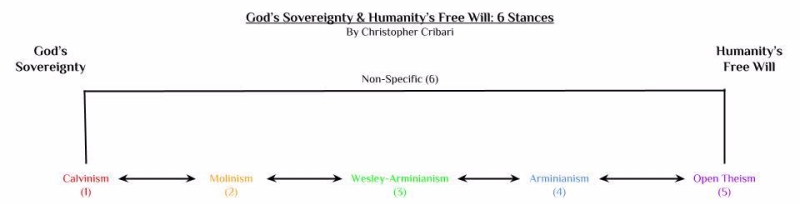
In other words, a Calvinist is a Christian that sees everything with an over-emphasis on God’s Sovereignty, which entails either a deterministic or compatibilistic philosopical view of the world. Here is a quick illustration that I made to put into perspective where Calvinism stands in the grand spectrum of the issue of God’s Sovereignty vs. Humanity’s Free Will within Christianity:

God's Sovereignty & Humanity's Free Will- 6 Stances

One last thing is that when I refer to a Calvinist or Calvinism, I am referring to a 5-Point Calvinist. Not those that claim to be any combination that is short of a 5-Point Calvinist like a 4-Point Calvinist or a 2-Point Calvinist. But the whole point of the 5 points of Calvinism is that they are supposed to work together like the pillars to a building. By removing one point you fracture the legitimacy of the other four points and the foundation of Calvinism in general because they were designed by John Calvin to work together, not to work independently of each other. With that said, let’s look at my objections and see why I am not a Calvinist.

1) Calvinism is Great Exegesis Without Hermeneutics

In general, with the Calvinistic perspective on Scripture, there are massive misinterpretations of certain passages within the Bible. Most notably, Scriptures such as Romans chapters 9-11, John chapter 6, Ephesians 1:1-4, and the list goes on. In contrast, there are Scriptures like 1 John 2:2, Romans 1:16-17, or 1 Timothy 2:3-6 that explicitly go against Calvinism. Put simply, context is key and exegesis without context is like a madman with a sword.

2) Calvinism Makes Sharing the Gospel Logically Incoherent

If you think about the Gospel from the Calvinist perspective, Jesus only came to save the elect, only the elect will go to Heaven, and only the elect will get saved. So then sharing the Gospel becomes useless and pointless because those who are predestined to go to Heaven will go to Heaven and those who are predestined to go to Hell will go to Hell, while at the same time you have no say in the matter.  As Bryson put it in his book, The Five Points of Calvinism, “You will be saved or damned for all eternity because you were saved or damned from all eternity.” (Bryson, 121). Although some of the most prominent preachers have been Calvinists like Charles Spurgeon, their actions are not logically consistent with determinism. It is the equivalent of preaching to tombstones because no matter what some people are just doomed to damnation because it somehow glorifies God.

3) Calvinism Makes God the Author of Evil

If God is completely sovereign, then from the Calvinistic perspective God is the author of evil because He brought it into existence. This goes against everything that characterizes God as worthy of worship and completely good. How can a perfect being bring about imperfection? Only through the Calvinistic perspective is this possible because God is the cause of everything that exists including evil, instead of Eve and Lucifer bringing sin into God’s creation by going against God in their own free will. Philosopher William Lane Craig on the subject of Calvinism once said “according to this view (causal determinism and compatibilism), the way in which God sovereignly controls everything that happens is by causing it to happen, and freedom is re-interpreted to be consistent with being causally determined by factors outside oneself (6).”

So since God is ultimately the first cause of everything, God is therefore the author of evil and good. Something that is completely contradictory to the Bible and Judeo-Christianity as a whole. There are even Calvinist’s that affirm that God is the author of evil. People like R.C. Sproul Jr. affirm this idea of God being the author of evil several times throughout his book (7) that deals with this issue.

Now these are just 3 of many objections I have to Calvinism and are just reasons as to why I do not affirm to be Calvinist. Other objections I have include sin being excusable or God lying to people in the Bible, but that would take awhile to explain every objection I have to Calvinism, so for the sake of time I only chose 3 objections. Hopefully, this helps you with understanding this issue and maybe one day you can decide where you stand on the issue of how God’s Sovereignty and Humanity’s Free Will interact together. My advice for those of you do not understand this issue quite yet is to just believe what the Bible affirms: 1) that God is Sovereign and 2) that humans have Free Will. This is the safest stance concerning this issue because it is strictly Biblical avoids the gridlock nature of philosophical schools of thought like Calvinism among others. With that, Godspeed and Jesus bless!

Footnotes

  1. https://restorethegospel.wordpress.com/2009/11/19/a-conversation-about-calvinism-and-arminianism/
  2. https://youtu.be/fPpkSiO1Ci
  3. The Five Points of Calvinism, George L. Bryson
  4. http://freethinkingministries.com/the-petals-drop-why-calvinism-is-impossible/
  5. https://www.gotquestions.org/Calvinism-vs-Arminianism.html
  6. http://www.reasonablefaith.org/molinism-vs-calvinism
  7. http://www.reclaimingthemind.org/blog/2008/09/taking-calvinism-too-far-rc-sproul-jr%E2%80%99s-evil-creating-deity/http://amzn.to/2xM4F1Q
  8. Disclaimer